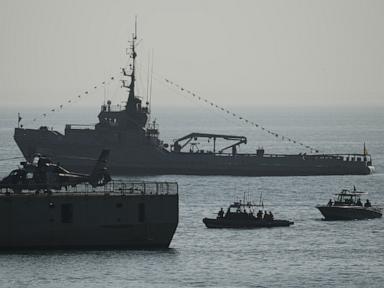
The Trump administration says it is seeking to expand its lethal campaign of bombing boats off Latin America’s Caribbean and Pacific coasts onto land MEXICO CITY -- Hundreds of people have been killed in the year since the U.S. military began bombing boats it accused of ferrying drugs off Latin America's Caribbean and Pacific coasts. Now, the Trump administration says it is seeking to extend that lethal campaign to land, pursuing deals that would put U.S. forces on the ground in allied nations across the region. President Donald Trump’s defense secretary, Pete Hegseth, announced last week during a visit to Panama that Colombia, Guatemala and Honduras had agreed to allow the U.S. to carry out joint military operations against criminal groups on their soil, following Ecuador, which launched similar missions with the U.S. in March.
Guatemala, however, has denied reaching such an agreement. It will be “like you saw with the strikes on the drug boats,” Hegseth said during a military drill in the jungle in Panama. And so we’re working with Ecuador.
We’re working with Colombia. We’re working with partners to bring the fight to the (designated terrorist organizations) on land.” The expansion marks a new phase in the Trump administration’s campaign to pressure governments across Latin America to align with its security priorities and assert what it calls “American dominance over the Western Hemisphere." Voters across the region are increasingly embracing Trump-aligned leaders, giving Washington more willing partners. But critics warn that the widening U.S. military campaign risks civilian casualties and a backlash against the U.S. that could outlast the Republican administration.
This is not cooperation, it’s obviously a very asymmetrical relationship.” The U.S. military has operated in Latin America for generations, supplying allies with weapons, intelligence and training to fight drug trafficking, while leaving a fraught legacy of support for military coups and dictatorships. But since Trump returned to office in January 2025, Washington has pursued its most interventionist approach to the region in decades. His administration has designated 20 Latin American criminal groups as “foreign terrorist organizations,” sent U.S. forces into Venezuela to capture its president and involved CIA agents in drug lab busts in Mexico.
It has killed more than 200 people in over 60 boat strikes in the Caribbean and eastern Pacific, offering little evidence that those targeted were “narco-terrorists” and drawing questions about the strikes’ legality. But sustained U.S. combat operations alongside local forces would be “new and different,” said William LeoGrande, a Latin America specialist at American University, testing deep-rooted sensitivities over national sovereignty and the presence of U.S. troops. Hegseth provided few details about what joint operations with Colombia, Guatemala and Honduras would look like.
But in Colombia, where Trump-backed Abelardo de la Espriella took office this month, he raised the prospect of U.S. forces joining strikes against armed groups including the National Liberation Army, or ELN, Colombia’s last major guerrilla group. Hegseth said de la Espriella had requested greater U.S. military involvement. On Saturday, following a drone attack by the ELN on troops, de la Espriella vowed the rebels would “pay a high price." Ecuador has emerged as the clearest case of direct U.S. military involvement, launching joint raids with Washington despite voters overwhelmingly rejecting foreign military bases in a November 2025 referendum.
Extract — continue reading at the source.