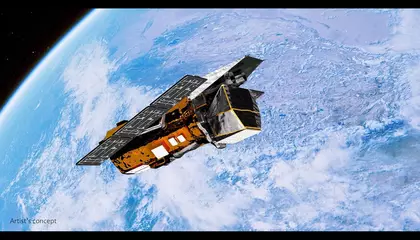
NASA’s groundbreaking Neil Gehrels Swift Observatory, which stared at the cosmos for more than two decades, is expected to crash down to Earth this week. Space Force estimates the beloved space telescope will re-enter the planet’s atmosphere around November 4, where most of it should burn up. At least in low-Earth orbit, what goes up must come down.
And that end is catastrophic,” says John Nousek, an astronomer at Pennsylvania State University who led the control team, to Marcia Dunn at the Swift’s fiery death comes after an attempted Hail Mary earlier this year. The aging telescope recently had been falling from its orbit faster than predicted because of unusually strong solar activity in late 2024. That increased atmospheric drag on the observatory, pulling it down.
In response, NASA contracted Arizona-based company Katalyst Space Technologies to build a spacecraft that would use robotic arms to lift Swift back into higher orbit. It launched on July 3, but the first-of-its-kind mission failed when the rescue craft had issues with its orientation control system, among other problems. Scientists are now mourning the loss of Swift.
It launched in November 2004 for what was supposed to be a two-year mission to study gamma-ray bursts. They’re the most powerful explosions in the universe and often associated with the collapse of massive stars or the birth of black holes. Instead, the observatory spent 22 years observing more than 2,000 gamma-ray bursts, 1,400 supernova explosions, stars being shredded by black holes, asteroids, comets and countless other cosmic phenomena and objects.
Its data was quickly accessible to researchers, and by the end of its career, it had contributed to roughly 7,000 scientific papers. Some of the telescope’s biggest discoveries happened in 2017, when it detected signs of a merger between two dense stellar leftovers, called neutron stars, and helped trace a ghostly, high-energy neutrino particle to its origin. Swift was considered a first-responder telescope.
It provided alerts about interesting phenomena, which other instruments, like the Hubble Space Telescope and James Webb Space Telescope, followed up on for more thorough investigations, per the AP. NASA shut Swift down in late October because it was too unsteady. Without Swift, “we’re going to miss out,” says Judith Racusin, an astrophysicist at NASA’s Goddard Space Flight Center, to Meghan Bartels at Science News.
Extract — continue reading at the source.