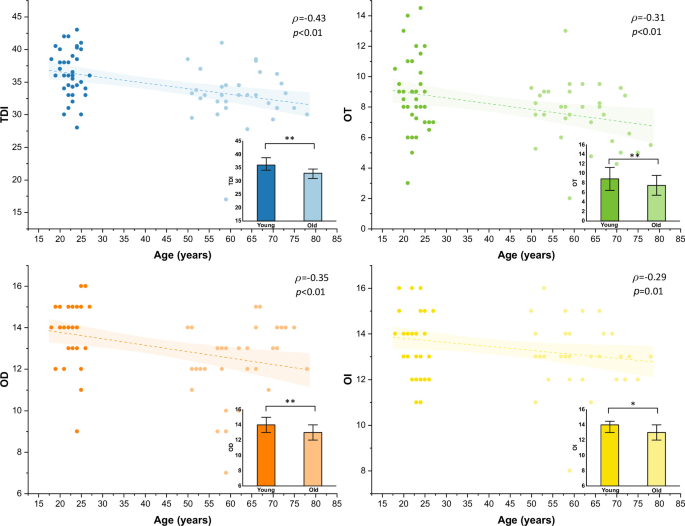
Age-related olfactory decline in humans is well-documented, yet the underlying peripheral neural mechanisms remain poorly understood. We investigated age-related olfactory decline across psychophysical, nasal mucosal, and central neural levels in 73 healthy adults across the lifespan. Participants underwent Sniffin’ Sticks testing and simultaneous recordings of mucosal electro-olfactograms (EOG) and cerebral chemosensory event-related potentials (CERP) in response to olfactory and trigeminal stimulation.
Older adults exhibited significantly lower psychophysical olfactory scores, prolonged CERP P2 latencies, and reduced spectral power across theta, delta, and beta bands at peripheral (EOG) and cerebral (Fz, Cz, and Pz) sites. These findings demonstrate a systemic decline of olfactory function. Although the olfactory mucosa remains functionally active, diminished neural recruitment and oscillatory power, coupled with slower central processing, characterize olfactory aging.
These objective electrophysiological markers provide a comprehensive profile of sensory decline in the aging population. The sense of smell allows us to perceive a wide range of odors, playing a crucial role in environmental hazard avoidance1, shaping our eating behavior2,3, facilitating social communication4,5, and even modulating our emotions6, memories7, and cognition8. Consequently, it is not surprising that olfactory loss can significantly impact quality of life9,10, well-being11, while also predict neurodegenerative progression12,13 and higher mortality risk14,15.
This profound link suggests that olfactory dysfunction is not merely a sensory deficit, but - much like the visual and auditory impairments, though less extensively studied - a critical physiological indicator of biological aging and systemic health. Aging is the most prominent risk factor for olfactory loss. Psychophysical tests consistently observe decreased olfactory sensitivity, discrimination, and identification in older individuals15,16,17.
Approximately 50% of individuals aged 65-80 years, and approximately 75–80% of those beyond 80 years, experience some degree of olfactory loss15,16,18. A meta-analysis of 175,073 participants also confirmed that olfactory dysfunction becomes more prevalent with age19. Beyond its sensory function, olfaction appears to be closely linked to the overall health of aging individuals, suggesting that it could serve as an early biomarker of age-related decline15,20.
The inevitable process of normal aging, combined with the significant consequences of olfactory loss, underscores the clinical importance of investigating the mechanisms of age-related olfactory dysfunction. Age-related olfactory dysfunction is considered to arise from multiple mechanisms, including degeneration of the olfactory epithelium, altered receptor function, reduction in mucosal metabolizing enzymes, changes in olfactory bulb volume or circuitry, and impairments in cortical processing21,22. However, evidence supporting these mechanisms has been derived from animal models, postmortem human tissue, or indirect behavioral assessments.
Extract — continue reading at the source.


