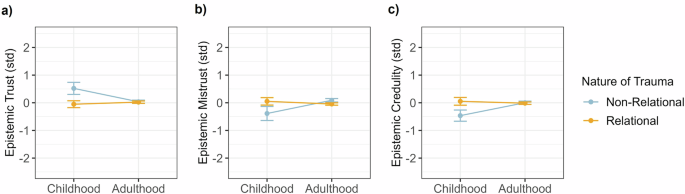
Traumatic experiences profoundly impact mental and physical health, alongside an individual’s trust in their social environment. Disruptions in epistemic trust – the capacity to evaluate and trust socially communicated information – are theorized to increase vulnerability to psychopathology by impairing social learning. This cross-sectional study investigated associations between trauma characteristics and epistemic stance using self-report data from a representative German sample (N = 2 519).
We examined relationships among trauma type, age at trauma, epistemic stance, PTSD and cPTSD. Neither trauma type nor timing alone predicted epistemic stance. However, their interaction revealed that early relational trauma demonstrated the strongest association with epistemic disruption.
Within epistemic stance, heightened credulity mediated associations between trauma and both PTSD and cPTSD symptoms. These findings align with the hypothesis that the association between trauma exposure and epistemic stance depends on trauma type and timing, with early relational trauma showing the strongest links to epistemic disruption and related psychopathology. This differentiated perspective on trauma characteristics highlights epistemic stance as a potential mechanism that may advance developmental models of psychopathology and future clinical research.
We thank Alina Klettke and Amelie Sophie Schäfer for their valuable assistance with the validation of the ITQ scoring scheme. Language refinement support was provided through the use of ChatGPT (OpenAI). Open Access funding enabled and organized by Projekt DEAL.
Institute of Psychosocial Medicine, Jena University Hospital, Jena, Germany Research Department of Clinical, Educational and Health Psychology, UCL, London, United Kingdom University Hospital of Psychiatry II, Department of Psychiatry, Psychotherapy and Psychosomatics, Medical University of Innsbruck, Innsbruck, Austria Ludwig Boltzmann Institute for Rehabilitation Research, Vienna, Austria Department of Psychosomatic Medicine and Psychotherapy, Justus Liebig University Giessen, Giessen, Germany Department for Psychosomatic Medicine and Psychotherapy, Medical Center of the Philipps University Marburg, Marburg, Germany VAMED Rehabilitation Center, Schruns, Austria German Center for Mental Health (DZPG), Halle-Jena-Magdeburg, Germany Center for Intervention and Research in adaptive and maladaptive brain Circuits underlying mental health (C-I-R-C), Halle-Jena-Magdeburg, Germany Centre for Human Neuroscience Research, Virginia Tech, Blacksburg, VA, USA Department of Psychosomatic Medicine and Psychotherapy, University Medical Center of the Johannes Gutenberg University Mainz, Mainz, Germany Clinic and Polyclinic for Psychosomatic Medicine and Psychotherapy, Rostock University Medical Center, Rostock, Germany Department of Child and Adolescent Psychiatry/Psychotherapy, University of Ulm, Ulm, Germany German Center for Mental Health (DZPG), Mannheim-Heidelberg-Ulm, Germany Department of Clinical Child and Adolescent Psychology, Otto Friedrich University Bamberg, Bamberg, Germany The authors declare that there were no conflicts of interest with respect to the authorship or the publication of this article. The study was reviewed and approved by the Ethics Committee of the Medical Faculty of the University of Leipzig (474/20-ek). Written informed consent to participate in this study was provided by all participants and, if applicable, their legal guardians.
Hypotheses and methods of this study were preregistered at https://osf.io/cxvej. The materials used in this study are widely available. Publisher’s note Springer Nature remains neutral with regard to jurisdictional claims in published maps and institutional affiliations.
Extract — continue reading at the source.


