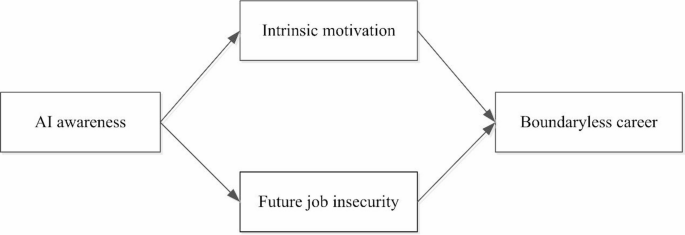
The in-depth penetration of artificial intelligence (AI) technology has reshaped career forms and the structure of the labor market, exerting a profound impact on university students’ cognition and orientation towards career development. Based on the conservation of resources theory and self-determination theory, we conducted three studies—an experimental study and two survey studies—to explore correlational linkages between AI awareness and university students’ boundaryless career. Studies 1 and 3 consistently demonstrated that AI awareness is indirectly associated with boundaryless career through the parallel mediating pathways of intrinsic motivation and future job insecurity.
Study 2 provided experimental evidence that heightened AI awareness increases both intrinsic motivation and future job insecurity. This research enriches the application scenarios of boundaryless career theory in the context of technological change, deepens the understanding of the mechanism linking technological perception to youth career psychology, and offers practical implications for career guidance in universities. Penetrating all sectors of economic and social operation at an unprecedented pace, Artificial Intelligence (AI) has become a core enabling factor that drives the upgrading of industrial structure and the restructuring of the labor market, which has prompted extensive scholarly attention to the intersection of digital transformation and career development1,2,3,4.
AI technology has fundamentally challenged the traditional stability and boundary attributes of the career concept5,6. It has also subverted the work content, task boundaries, and skill demand systems of traditional positions7,8,9. On one hand, AI technology encourages skill-biased technological advancement in the labor market by taking the place of monotonous and routine work10.
Because of this, advanced cognitive skills, multidisciplinary resource integration skills, and innovative problem-solving skills have progressively emerged as key benefits for people competing for jobs11. On the other hand, new professions, such as prompt engineers and AI trainers, have also emerged as a result of the iterative development of AI technology12. These professions defy the single-identity logic and linear promotion of conventional career development.
It enables individuals to achieve dynamic development through multi-project collaboration, cross-platform employment, and career identity transition13. More significantly, career uncertainty brought on by AI technology has evolved from transient market swings to a long-term, structural aspect of the labor market environment14,3. Workers are compelled by this feature to alter their reasoning regarding career advancement.
They move from passively accepting professional arrangements to self-driven career path planning, and from relying on organizations for stable employment security to proactively building continuous adaptive capacity15,8. In light of this, investigating how people perceive and react to career changes brought on by AI technology is a crucial first step in comprehending the logic of career construction in the new era16,7. In addition to changing traditional career paths, the development of AI technology has led to a paradigm shift in the meaning of boundaryless careers17,18.
Extract — continue reading at the source.