Artificial intelligence (AI) is increasingly used in healthcare to identify high-risk patients. Laboratory studies are mixed regarding patient attitudes towards AI use. Here we field-tested whether informing patients of their risk for influenza and its complications can serve as an effective behaviour-change intervention to increase vaccination, and whether disclosing AI use in the risk determination or providing personalized reasons for the algorithm’s prediction (a form of explainable AI) influence message effectiveness.
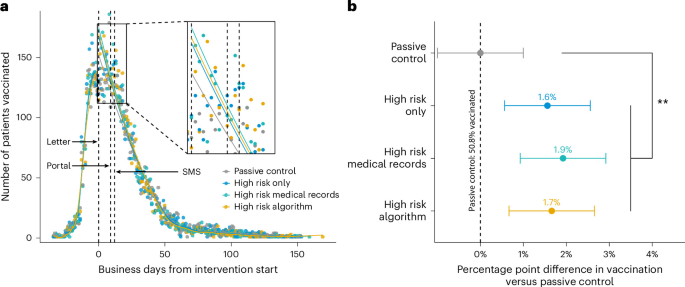
We ran three preregistered randomized controlled trials with over 90,000 unique healthcare system patients in the USA (ClinicalTrials.gov identifiers: NCT04323137, NCT05009251 and NCT05509283). Patients identified by a previously validated machine learning algorithm as being at high risk for influenza and related complications were randomized to be sent no message or one of several different messages encouraging influenza vaccination (the primary outcome). High-risk nudges increased vaccination: among patients informed of their high risk, vaccination was 1.1–1.4 percentage points (3.3–5.4%) higher than those simply reminded to get a vaccine, and 1.7–3.5 percentage points (3.3–14.7%) higher than non-messaged patients.
Vaccination was similar across message arms that did versus did not disclose ‘algorithm’ involvement or its risk explanations, indicating that patients are neither averse to nor appreciative of algorithm use or explainability in this realistic health application. This work was partially funded by the National Institute on Aging of the National Institutes of Health under award number P30AG034532. This is a preview of subscription content, access via your institution Access Nature and 54 other Nature Portfolio journals Get Nature+, our best-value online-access subscription Receive 12 digital issues and online access to articles Prices may be subject to local taxes which are calculated during checkout De-identified data necessary to reproduce all results reported here are posted on OSF at https://osf.io/mqbux/.
All data are posted at the individual level, except vaccination timing data (that is, vaccination dates) which are aggregated by experimental condition because dates of service are Protected Health Information under 45 CFR §164.514(b). Related documents available include study protocols and statistical analysis plans (available on ClinicalTrials.gov registrations, study 1: https://clinicaltrials.gov/ct2/show/NCT04323137; study 2: https://clinicaltrials.gov/ct2/show/NCT05009251; study 3: https://clinicaltrials.gov/ct2/show/NCT05509283; study 4: https://clinicaltrials.gov/ct2/show/NCT05509270). Code necessary to reproduce all results reported here is available via OSF at https://osf.io/mqbux/.
The impact of healthcare it on clinical quality, productivity and workers. Rajpurkar, P., Chen, E., Banerjee, O. & Topol, E. AI in health and medicine.
Artificial intelligence in sepsis early prediction and diagnosis using unstructured data in healthcare. Article CAS PubMed PubMed Central Google Scholar Tomašev, N. et al. A clinically applicable approach to continuous prediction of future acute kidney injury.
Extract — continue reading at the source.


