Modern environmental improvements have extended average lifespan, leading to increased prevalence of neurodegenerative diseases such as dementia. While memory decline is a natural physiological process of aging, numerous studies have demonstrated that certain genotypes increase the risk of cognitive decline and dementia. The apolipoprotein E (APOE) ε4 allele is a well-established risk factor for Alzheimer’s disease (AD), the primary cause of dementia.
APOE ε4 carriers not only have significantly elevated AD risk but also exhibit poorer cognitive performance and episodic memory decline. However, APOE ε4 alone inadequately predicts AD; its predictive power is limited by incomplete penetrance and polygenic interactions. Genome-wide association studies identify guanine nucleotide-binding protein beta polypeptide 3 (GNB3), a G-protein β subunit hub in APOE ε4-specific co-expression networks, but evidence linking GNB3 C825T to cognition or its interaction with APOE ε4 remains absent.
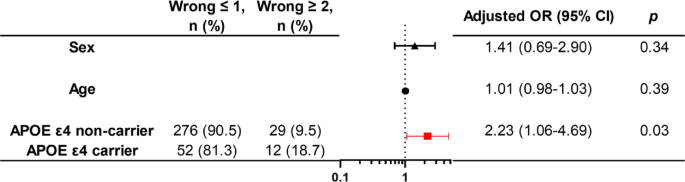
In this study, we genotyped APOE and GNB3 C825T (rs5443) in 369 cognitively healthy adults at a healthy aging exhibition in Taiwan and assessed short-term memory performance. APOE ε4 carriers showed poorer short-term memory performance compared with non-carriers. While GNB3 genotype alone was not associated with memory performance, subgroup analyses suggested a trend toward poorer performance among APOE ε4 carriers with the GNB3 T allele (OR = 2.08, p = 0.08).
However, formal interaction analysis did not demonstrate a statistically significant interaction effect. These findings suggest a potential association between APOE ε4 and short-term memory performance and indicate that GNB3 genotype may influence this relationship. Dementia and other neurodegenerative disorders have become increasingly prevalent with global population aging and shifting lifestyle patterns.
According to updated estimates from Alzheimer’s Disease International, more than 50 million people worldwide were living with dementia in 20201. The World Health Organization further projects that this number will rise to 152 million by 20502. Although age-related memory decline is a normal physiological process, certain genetic factors have been shown to increase the risk of accelerated cognitive impairment and dementia3,4.
Among these, the apolipoprotein E (APOE) gene, particularly the ε4 allele, is the most widely recognized genetic risk factor for Alzheimer’s disease (AD), the major cause of dementia5,6. The APOE gene encodes a multifunctional protein that plays key roles in neurogenesis, synaptic plasticity, and neural repair mechanisms7. The APOE genotype is determined by two functional single nucleotide polymorphisms in exon 4, rs429358 (c.388T > C) and rs7412 (c.526 C > T), which together define the three major allelic isoforms: ε2 (T/T), ε3 (C/T), and ε4 (C/C)8.
Extract — continue reading at the source.


