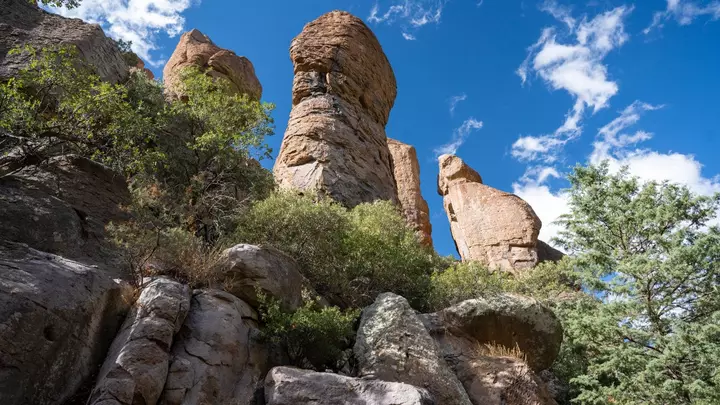
Chiricahua National Park features unique rock formations and dramatic landscapes. ( ) President Trump recently designated America’s newest national park, the Chiricahua National Park in southeast Arizona. By all accounts, it’s a stunning place known for its vertical rock spires, but like most things that happen today, Chiricahua’s new designation has been divisive. Some of us are excited about its protections, and curious about what areas might be our next full-fledged national park, while others are wondering if we should establish new parks at all.
On one hand, the national park designation represents one of America’s most comprehensive forms of land protection, while also serving as an economic boon to the communities surrounding these parks. On the other, the national park service is suffering from a budgetary crisis, so why add another unit to the problem? Another argument against adding it: the best landscapes are already protected as national parks, and these recent additions don’t deserve the same status as awe-inspiring parks like Yosemite or the Grand Canyon.
I can see the logic on both sides, so let’s step back and examine the bigger picture behind the national park expansion debate. We all know the parks are “America’s best idea,” but what’s the purpose behind that idea? The first national park, Yellowstone, was established in 1872, before the concept of a national park system was even in place.
The National Park Service wasn’t established to manage Yellowstone and the other parks until 1916 with the signing of the Organic Act by President Woodrow Wilson. This document outlined the purpose of our national park system, stating that the park service was meant to “conserve the scenery and the natural and historic objects and the wildlife therein and provide for the enjoyment of the same in such manner and by such means as will leave them unimpaired of the enjoyment of future generations.” So, conservation and public enjoyment. But how does a landscape actually achieve national park status?
Today, there are 433 units within the national park system, ranging from small national historic parks to large-scale national monuments and recreation areas. Of those different areas, only 64 have full national park status. There is only one pathway to full national park status: an act of Congress.
While presidents can establish national monuments on existing public lands using the Antiquities Act of 1906, the only way any parcel of land gets that top-tier designation to a national park requires both the House and the Senate to pass enabling legislation, and then for the President to sign it. There have been a number of bills introduced trying to create new national parks that have gone nowhere, while others took years to get legislative footing. It took two different bills introduced at different times to get Mesa Verde in Colorado established.
Extract — continue reading at the source.