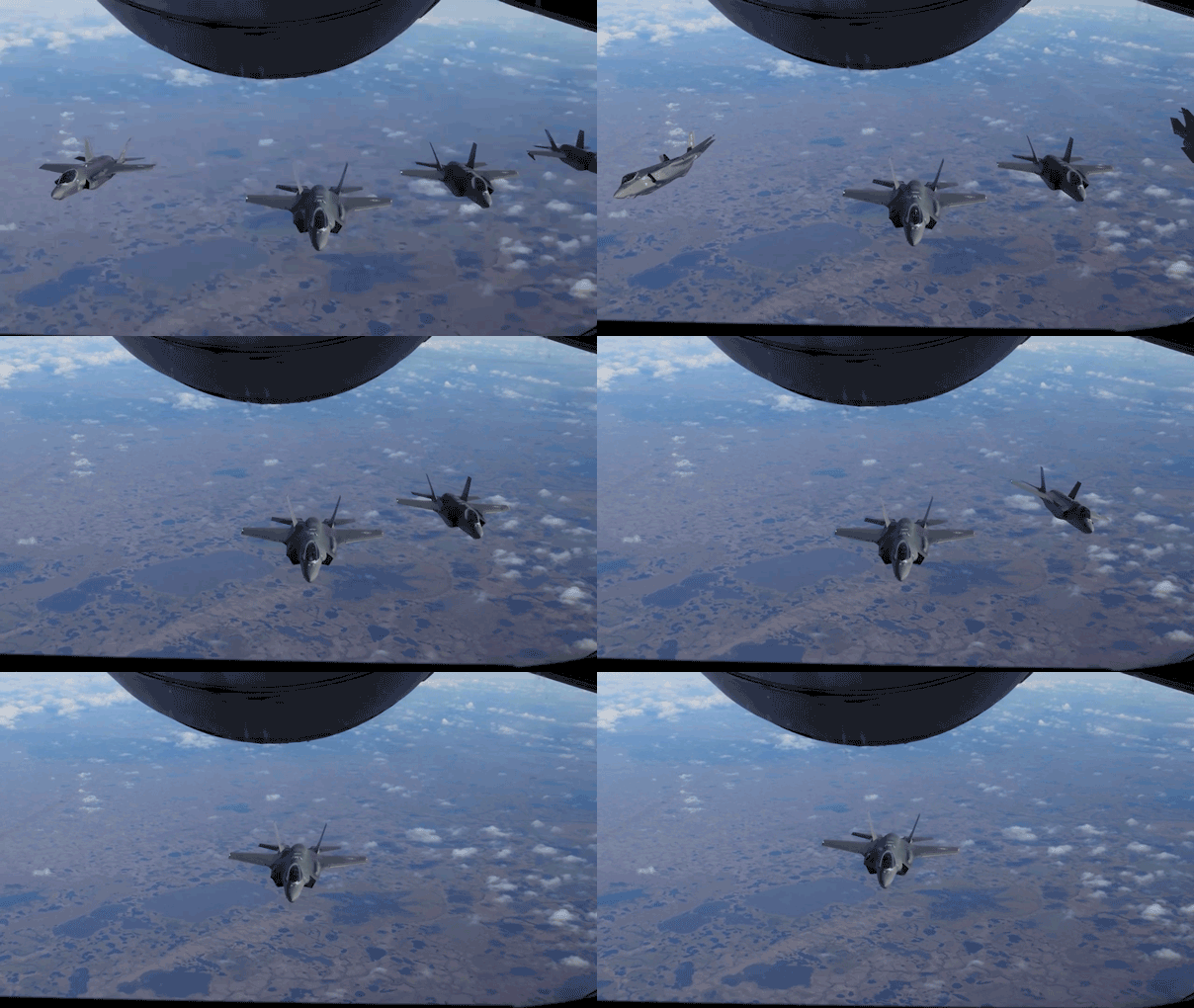
Across one of the coldest, most remote and strategically exposed corners of the United States, American forces are practicing how to fight on land, at sea and in the air — rapidly moving rocket systems into western Alaska, sending F-35s and F-16s toward simulated threats and coordinating U.S. and Canadian warships in the Bering Sea. The operations are part of Tundra Merlin, an enduring U.S. military campaign aimed at proving that even across Alaska’s vast distances and extreme Arctic conditions, American and allied forces can rapidly assemble combat power to defend the northern approaches to the homeland. And behind that show of force is a changing security environment increasingly shaped by Russia and China.
TWO ICEBREAKERS HEADED TO ALASKA AS US COMBATS RUSSIAN, CHINESE INFLUENCE IN ARCTIC "I think what’s changed is primarily two things," Lt. Robert Davis, commander of Alaskan Command, told Fox News Digital. "One is that the melting sea ice has made the Arctic more accessible.
And we’re seeing increased activity both commercially and militarily in the Arctic, particularly during the summer months." "The other factor is that China and Russia and others are continuing to advance their military capabilities and capacity with an interest in showing that they can use them in the Arctic as well," Davis said. The Pentagon has reached a similar conclusion. Its 2024 Arctic Strategy warned that growing Russia-China cooperation could "alter the Arctic’s stability and threat picture," and called for greater U.S. presence, exercises and military preparedness in a region becoming increasingly accessible.
Defense officials have said forces operating there must be able not merely to train in extreme conditions, but survive them. RUSSIA PULLED BACK FROM THE ARCTIC, FOR NOW. NATO MUST ACT BEFORE THOSE TROOPS RETURN Few places illustrate the stakes better than Alaska.
The state sits at the intersection of the Arctic and Pacific and serves as a critical hub for homeland defense and a platform for projecting U.S. military power toward the Indo-Pacific and beyond. The Russian and American mainlands are only about 55 miles apart at their closest points across the Bering Strait, while Russia’s Big Diomede Island and Alaska’s Little Diomede Island are separated by roughly 2.5 miles. Alaska also hosts major air bases, early-warning and missile-defense infrastructure and tens of thousands of military personnel.
Northern Command says Alaskan Command has more than 22,000 active-duty personnel from across the services, along with approximately 4,700 Guard and Reserve members. Air Force officials have described Alaska as the "crossroads of the Arctic and the Pacific," providing U.S. forces with reach and domain awareness for both homeland defense and global power projection. Davis put that geography in even starker terms.
Extract — continue reading at the source.