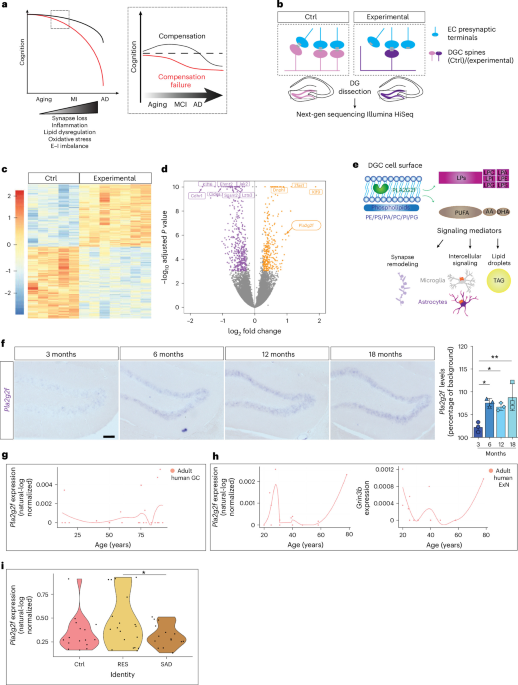
Cognitive reserve theory posits that compensatory mechanisms during aging stave off cognitive decline and lower risk for Alzheimer’s disease. Here, in a screen for hippocampal dentate granule cell (DGC) synapse loss-induced factors in mice, we identified a secreted phospholipase, Pla2g2f, whose expression increases in DGCs during aging and is associated with cognitive resilience in humans. Pla2g2f deletion in DGCs exacerbates aging-associated pathophysiological changes, including synapse loss, inflammatory microglia, reactive astrogliosis, impaired neurogenesis, lipid dysregulation, lipid droplet accumulation and hippocampal-dependent memory loss.
Conversely, boosting Pla2g2f in DGCs during aging is sufficient to prevent these pathophysiological alterations in hippocampal–cortical circuits, protect memory and prophylactically modify trajectory of cognitive decline. Mutagenesis of the catalytic site of PLA2G2F prevented lipid droplet mobilization and reduction of reactive gliosis and inflammatory microglia. Neuronal PLA2G2F mediates intercellular signaling to decrease lipid droplet and cholesterol ester load in human induced pluripotent stem cell-derived microglia.
Our findings implicate PLA2G2F as a compensatory neuroprotective broadcast signal that maintains lipid homeostasis to counteract aging-associated cognitive decline. The hippocampus plays a crucial role in the registration of our experiences as episodic memories and includes the dentate gyrus (DG) subregion that contributes to memory formation by decreasing memory interference1. Furthermore, dysfunction in DG is considered to be a primary driver of aging-associated cognitive decline and a hallmark of mild cognitive impairment (MCI)2.
Healthy cognitive aging depends on a balance of resilience and vulnerability factors that dictate the tempo of pathophysiological alterations, such as synapse loss3,4, lipid dysregulation5,6,7,8,9, emergence of maladaptive ‘inflammatory’ microglia6,10,11 and reactive astrogliosis12,13, oxidative stress14,15, loss of hippocampal neurogenesis16, and excitation–inhibition imbalance2,17,18. Disruption of this balance leads to a trajectory of cognitive decline and increased risk for MCI and Alzheimer’s disease (AD). A complementary perspective, first offered within the framework of cognitive reserve theory, posits that pathological cognitive decline reflects a failure to compensate for the progressive increase in pathophysiological alterations over time19 (Fig. 1a).
Studies in rodents and humans suggest a role for re-organization of neural activity patterns and network level functional connectivity, increases in large-diameter head dendritic spines and changes in synaptic gene expression as substrates for functional compensation during aging20,21,22,23,24,25,26; however, the identities of the underlying mechanisms have remained elusive. Consequently, and in contrast to our understanding of how molecular factors mediating resilience and vulnerability influence cognitive reserve in aging19,27,28, a mechanistic instantiation of how compensation confers cognitive resilience in aging is still lacking. Evidence for endogenous compensatory cognitive resilience mechanisms should fulfill the following criteria.
First, such a mechanism must be naturally engaged in response to pathophysiological alterations during aging. Second, blockade or disruption of such a mechanism must exacerbate aging-associated pathophysiological alterations. Third, boosting such a mechanism must confer cognitive resilience and prevent cognitive decline during aging.
Extract — continue reading at the source.