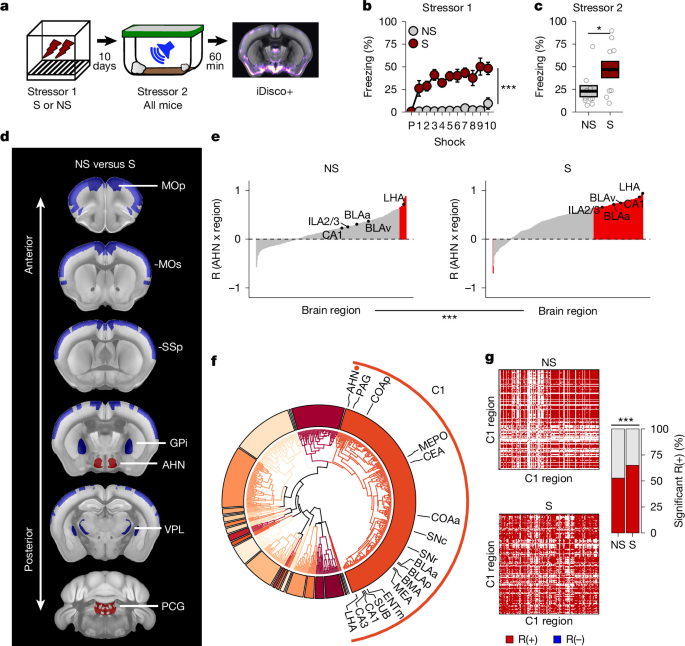
Previous adversity increases sensitivity to subsequent stressful events1,2,3,4,5,6,7,8, but the causal underlying changes in brain circuitry are poorly understood. Here we harnessed unbiased whole-brain activity mapping to identify circuits that are functionally remodelled by previous adversity to promote heightened stress sensitivity. The anterior hypothalamic nucleus (AHN)—a region that has received little attention until now in the context of stress—displayed heightened stress reactivity in previously stressed mice.
This was accompanied by increased correlational strength between the AHN and a threat-related brain network. Using in vivo Miniscope imaging, we then found that neuronal activity in the AHN scales with negative valence. Moreover, previous stress amplified the proportion of valence-sensitive AHN neurons, indicating inflated processing of negative valence in the AHN might drive heightened stress sensitivity.
Providing causal support for the role of AHN in negative valence and stress sensitivity, inhibiting AHN neurons blunted, and exciting their activity promoted, stress responses. Finally, amygdala neurons that project to the AHN were found to track negative valence, and silencing amygdala inputs to the AHN abolished sensitized stress responses. These findings define a key role of the AHN in regulating negative valence signals from the amygdala and highlight a new pathway that heightens sensitivity to stressful events.
The brain’s response to stress is fundamentally protective, engaging physiological and behavioural adaptations that promote survival. However, stressful experiences can also precipitate maladaptive brain plasticity, increasing susceptibility to debilitating mental health conditions such as post-traumatic stress disorder (PTSD)1,2,9. Notably, there is substantial variation in how people cope with stressful life events.
Exemplifying this, only a small proportion of people who experience a traumatic event go on to develop PTSD or other stress-related illness2. One factor that has been shown repeatedly to contribute to this variation is the experience of previous stress—people exposed previously to severe stress are more likely to develop PTSD or depression in response to a subsequent stressor1,3,4,5,9. Similarly, a core symptom of PTSD is hypervigilance, characterized in part by heightened reactions to even minor stressors10.
These findings point to the sensitizing effects of stress. The phenomenon of stress sensitization has been observed across species6,8,11 and could contribute to several of the deleterious consequences of stress. How this sensitization is embedded in the nervous system remains unclear.
Extract — continue reading at the source.


