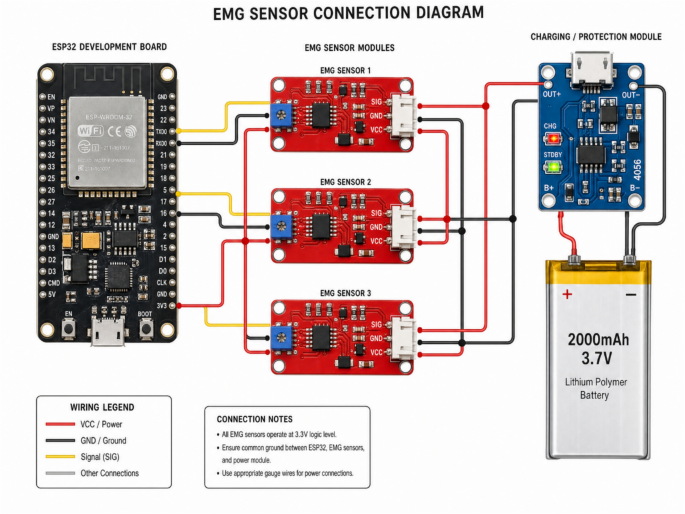
Wearable surface electromyography (sEMG) systems show strong potential for real-time gait analysis, yet few frameworks combine wireless acquisition, standardized normalization, and optimized machine learning within a single validated pipeline, leaving their joint contribution to subject-independent locomotor recognition unclear. This study developed and validated a custom wireless sEMG framework combining hardware design, normalization evaluation, and Bayesian-optimized machine learning for locomotor-task classification and neuromuscular characterization. An ESP32-based system recorded tibialis anterior, soleus, and gastrocnemius lateralis activity in 25 healthy participants during level walking, stair ascent, and ramp ascent.
Signals were bandpass filtered (20–500 Hz), rectified, and used to extract 120 time-, frequency-, and time–frequency-domain features. Three normalization strategies, three feature-selection methods, and eight Bayesian-optimized classifiers were evaluated via an exploratory participant-level split, nested 5 × 5 cross-validation, leave-one-subject-out (LOSO) validation, and an independent test set. Task-dependent EMG differences were significant with large effect sizes (η2 = 0.183–0.708, p
Extract — continue reading at the source.


