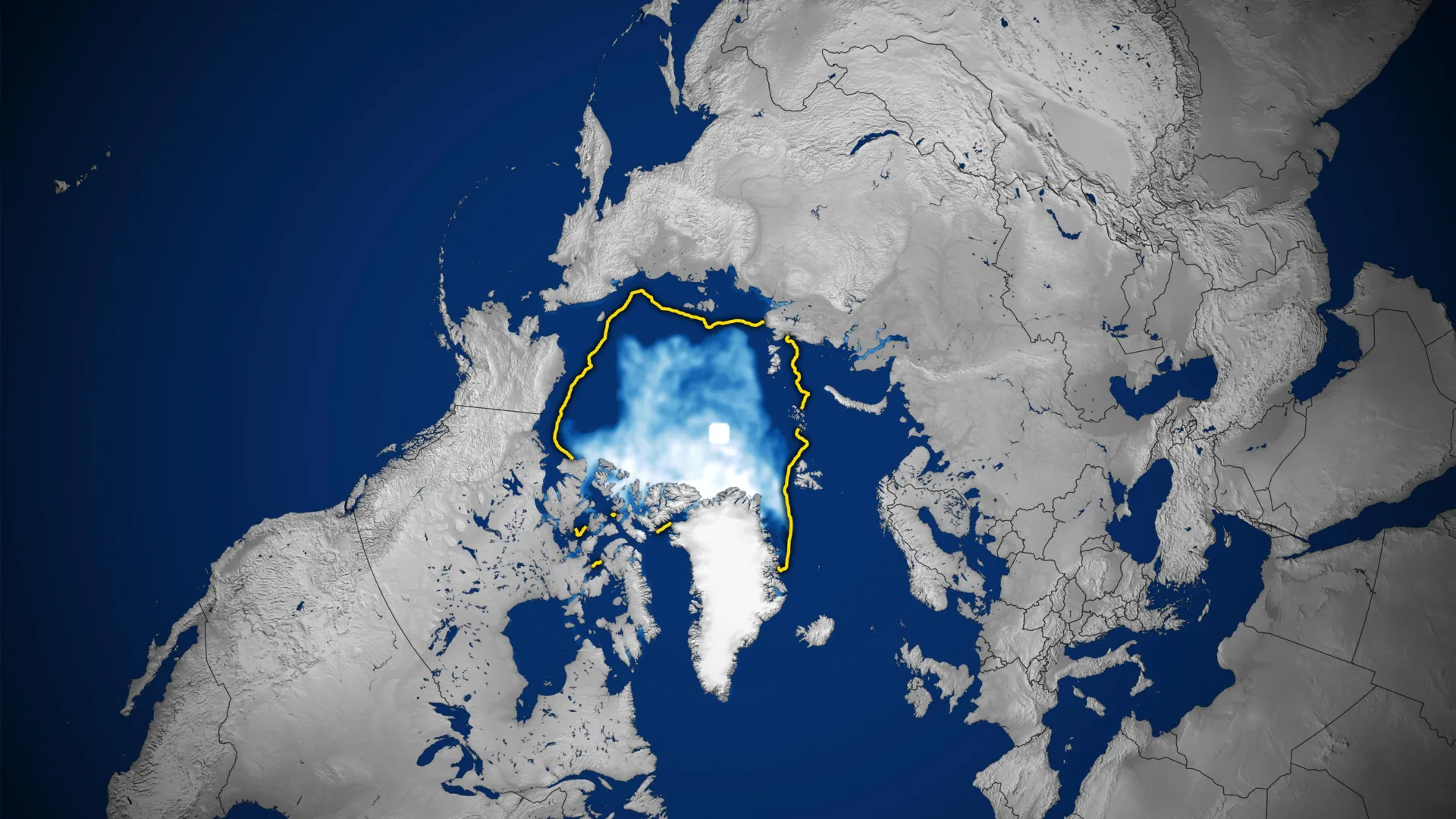
Nearly five decades of satellite observations reveal a troubling transformation in the Arctic, where sea ice is shrinking in both summer and winter, and much of the remaining ice is becoming younger and thinner. The Arctic Ocean is covered by a vast expanse of frozen seawater that expands and contracts with the seasons. Ice typically builds up throughout the long, dark winter, reaching its greatest extent in March before retreating during the warmer months to a September minimum.
This seasonal cycle has continued for thousands of years, but satellite measurements reveal that the amount of ice covering the ocean has declined substantially at both ends of the cycle. In 2026, Arctic sea ice reached its annual minimum extent on September 12 (above), covering approximately 4.6 million square kilometers (1.78 million square miles). According to NASA and the National Snow and Ice Data Center (NSIDC), this tied the minimums recorded in 2008, 2010, and 2025 for the 10th-lowest level since satellite monitoring began.
The maps below illustrate how Arctic sea ice has changed over time, comparing September conditions since 1990 (left), when ice coverage is typically at its lowest, with the following March (right), when it approaches its annual peak. The sequence continues through March 2026. Satellites have continuously tracked the seasonal expansion and retreat of Arctic sea ice since late 1978, providing scientists with nearly five decades of observations.
Those measurements reveal a long-term decline that accelerated during the 2000s, leading to a succession of exceptionally low ice levels. One particularly striking pattern is that every summer from 2007 through 2026 ranks among the 20 lowest September sea ice extents in the satellite record. The smallest extent ever observed occurred in September 2012.
However, the rate of summer ice loss has not been consistent. During the past decade, September sea ice coverage has remained comparatively stable rather than continuing its earlier rapid decline. Scientists emphasize that short-term weather conditions can strongly influence how much ice disappears in any given summer.
For instance, increased cloud cover over the Arctic during recent years has reduced the amount of sunlight reaching the ice, helping to limit additional melting. NASA researchers have identified this as one factor contributing to the recent slowdown. Even with that temporary stabilization, however, September ice coverage remains far below its historical average.
Extract — continue reading at the source.