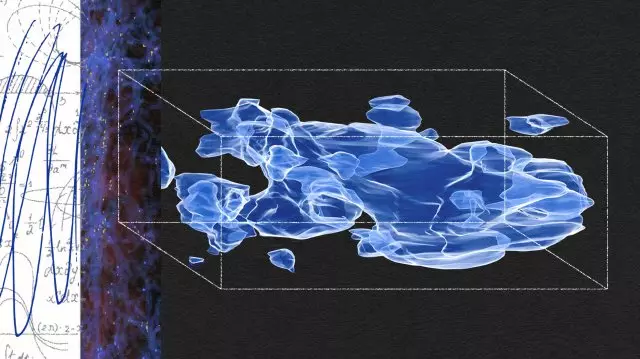
Whenever the topic of dark matter comes up, the most common question that people wonder about it is whether this mysterious, hypothetical substance really exists, and whether it truly dominates the matter content in our Universe as thoroughly as its adherents say it does. Some advocate for a position where dark matter doesn’t exist, and that there’s just a large amount of normal matter that’s unseen to hold the Universe together. Others advocate for a scenario where there’s only a “normal” amount of normal matter alone, and that instead of dark matter to provide the needed gravitational glue to hold structures together, a modification to the laws of gravity will do the trick instead.
But those advocates are an extraordinarily slim minority of working scientists: a group of contrarians whose claims fail to explain the overwhelming majority of evidence. Dark matter’s existence is overwhelming accepted by astrophysicists and cosmologists who work with the actual Universe as we observe it, with the alternatives all failing to match those observations without invoking either some form of dark matter or something that behaves identically to it. Instead of arguing over the existence or non-existence of dark matter, the community has largely moved on to the next step: attempting to characterize dark matter, and to figure out what type — or flavor — of dark matter actually exists within our Universe.
Here’s the story from the cutting edge that everyone should know. Our galaxy is thought to be embedded in an enormous, diffuse dark matter halo, indicating that there must be dark matter flowing through the solar system. Although we have yet to detect dark matter directly, the fact that it’s all around us makes the possibility of detecting it, if we can surmise its properties correctly, a real possibility in the 21st century.
It’s important to recognize that there’s an enormous suite of evidence in support of dark matter, observationally, that no alternative can explain equally well. And there are many other lines of evidence as well that all support dark matter’s existence, as this one additional ingredient in the Universe can sufficiently explain them all. Sure, we haven’t directly detected the underlying particle responsible for dark matter (assuming there is one), but there’s no guarantee that we’ll be able to do so, even in principle.
The observational evidence, even though it’s indirect, is sufficiently overwhelming to convince all but the staunchest contrarians that dark matter does indeed exist. The X-ray (pink) and overall matter (blue) maps of various colliding galaxy clusters show a clear separation between normal matter and gravitational effects, some of the strongest evidence for dark matter. The X-rays come in two varieties, soft (lower-energy) and hard (higher-energy), where galaxy collisions can create temperatures ranging from several hundreds of thousands of degrees up to ~100 million K.
Meanwhile, the fact that the gravitational effects (in blue) are displaced from the location of the mass from the normal matter (pink) shows that dark matter must be present. Without dark matter, these observations (along with many others) cannot be sufficiently explained. . Harvey (École Polytechnique Fédérale de Lausanne, Switzerland; University of Edinburgh, UK), R.
Extract — continue reading at the source.