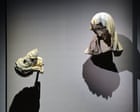
The nose of Cleopatra VII was supposed to have been so beautiful that it changed the course of history: if it had been shorter, French philosopher Blaise Pascal wrote, “the whole face of the earth would have changed”. A visit to the Palazzo Strozzi in Florence, however, will leave you convinced that Cleo’s conk was only the second most stunning feature to ever grace the face of an Egyptian pharaoh. Among the more than 80 objects on display at an exhibition that opened last week is an astonishingly lifelike sculpture showing off the lips of Akhenaten, from the 14th century BC: a seagull shape resting on a pillow of lush flesh, at once both stern and sensuous, almost uncomfortably kissable.
It was Thomas Aquinas who first came up with the theory that we perceive things to be beautiful when they are intact and whole, but the Akhenaten sculpture is so striking precisely because it has a major blemish. Like all the objects shown in Florence, it is only a fragment: a shard of polished limestone found in the dumps south of the Great Aten Temple in the city of el-Amarna, showing only the ruler’s nose and mouth. Fragments make you think about objects in a different way.” Entitled Broken: The Power of Fragments, the show that Dickerson has co-curated for the Palazzo Strozzi and the National Gallery of Art in Washington DC explores why people throughout history have gone to great lengths to damage or destroy carefully crafted sculptures and statues.
But along the way, it raises an even more intriguing question: why it is that some works of art have a more powerful emotional pull in a broken state than when whole? Many of the objects shown here speak of fault lines in history. There is a decapitated lifesize statue of a kneeling prior from Romainmôtier in Switzerland, likely beheaded during the iconoclastic frenzy of the Protestant Reformation.
The dismembered left foot and right hand of King Louis XIV is all that remains of an equestrian monument to the French royal after the revolution rolled across Paris’s Place Vendôme and put up a guillotine instead. Modernist sculptor Adolfo Wildt’s bust of Mussolini was adorned with a simple bullet through the forehead after the fall of the fascist regime. The vandals were following an age-old tradition, says co-curator Andrew Sears.
A 19AD bust representing Germanicus, heir to Tiberius, had its nose expertly hacked off, upper earlobes cut and forehead adorned with a cross by Christians who protested against the deification of Roman emperors. The past, we are reassured, was a foreign country with cruel rituals. Broken starts to get more surprising and interesting where it explores brokenness as more than a result of historical fractures.
A section called Sculpting the Fragment opens with an intriguing dogū figurine from ancient Japan. Little is known about these small, fired-clay statuettes with bulging coffee-bean eyes other than that they have been found in pieces all over burial sites in Japan. Current research indicates that the function of dogū figurines may have been akin to modern-day birthday pinatas: smashed to celebrate not just the end of the old but also the start of the new.
Extract — continue reading at the source.