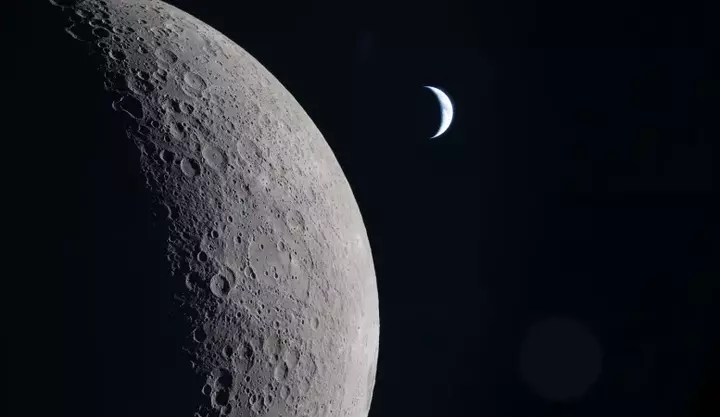
Six months after the Artemis II mission sent four astronauts around the moon, the value of their closeup view is coming into focus. The first science results, released on October 7, reveal details of the moon’s array of colors, how often it gets hit by tiny rocks and lessons for squeezing as much science as possible out of future human lunar missions. Astronauts Reid Wiseman, Victor Glover, Christina Koch and Jeremy Hansen spent about seven hours in close proximity to the moon taking scientific observations, describing the moon’s surprising colors and textures and witnessing a solar eclipse from space.
Almost all of that event was livestreamed. But the astronauts took thousands of photos, notes and audio recordings that weren’t immediately made public. Part of the science team’s job was to digest those observations and release the data to anyone who wants to study them within six months of splashdown on April 10.
With three days to spare, the team released three reports and a massive data archive on October 7, the 67th anniversary of when the Soviet Luna 3 spacecraft took the first photograph of the farside of the moon. The results offer a rare test of what trained human observers can add to lunar research and what NASA can learn for future missions to the lunar surface. After six months of hard work, “this is enabling science to happen for the next, I don’t know, 60 years, if not more.” Surprisingly, the most valuable data from the mission were not the mind-blowingly gorgeous photos, but the astronauts’ verbal and written descriptions of what they were seeing.
Before launch, the astronauts had extensive training in lunar geology and science observations. They were an extension of the science team, said field geologist Cindy Evans also of NASA Johnson Space Flight Center, one of the astronauts’ instructors. They understood the language of geology,” she said.
That training was meant to help answer a question Young hears often: What can humans add that a camera can’t? During the flyby, the astronauts worked in pairs. Two of them spoke to mission control on the ground, giving periodic updates to the science team on what they were seeing.
The other two recorded themselves describing their observations and reactions and used a stylus to annotate specially made maps of the moon that had been uploaded to their tablets during flight. Those notes, doodles and recordings were not made public until now. The idea was to give the crew high tech field notebooks, Young says.
Extract — continue reading at the source.