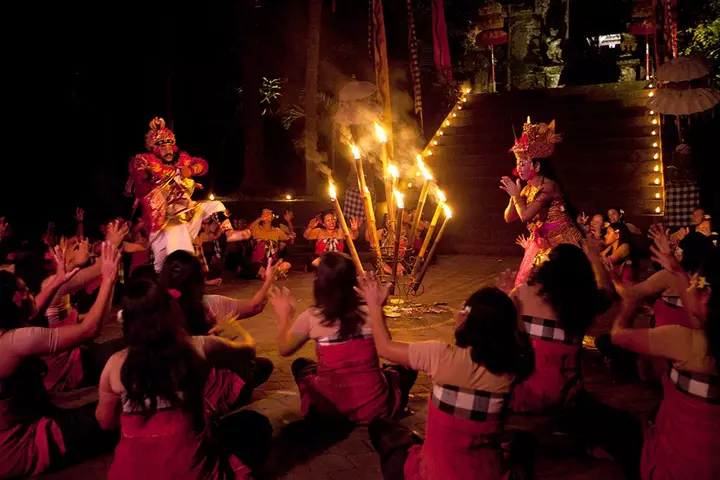
The icon indicates free access to the linked research on JSTOR. If you were asked to picture Balinese dancers, the Luh Luwih troupe might not be what comes to mind. Founded in 1995 as an offshoot of a pioneering _gamelan wanita_ (women’s orchestra), the thirty-member troupe is composed mostly of middle-aged women who have “set about performing the all-male genres one by one,” as scholar Catherine Diamond explains.
Dramatic dances such as _wayang wong_, based on the Hindu epic _Ramayana_, and _kecak_, or “monkey chant,” have traditionally been off-limits to women. In _wayang wong_, for example, performers enact fight scenes between monkeys and demons. But far from shying away from such genres, Luh Luwih has introduced its own artistic innovations.
In one _kecak_ performance, for example, the troupe features an all-female chorus and middle-aged women dancers, rather than male vocalists accompanying young women. According to Diamond, Balinese women’s unprecedented participation in historically male performance traditions “has been generally empowering, both musically and socially, while at the same time raising questions about modernity in the context of Balinese cultural values.” Beyond providing secular entertainment, the performing arts in Bali also have a deep spiritual dimension. Playing gamelan, for instance, can be seen as _ngayah_, or religious service.
This form of _ngayah_ was traditionally reserved for men, while women—who usually stopped dancing after marriage—performed _ngayah_ by making offerings such as rice cakes. The history of _kuda kepang_, the Javanese horse dance whose trance rituals continue to spark religious debate. Now, women musicians have embraced gamelan as _ngayah_ too.
As _gamelan wanita_ has grown in popularity since the 1980s, “women are taking on an additional commitment and responsibility by appropriating areas of artistic expression that had been arbitrarily denied,” says Diamond. Music isn’t the only arena in which older women are challenging traditional performance roles. Many now feel empowered to continue dancing—and aren’t content with being limited to the roles traditionally performed by younger women.
The island’s economy has become increasingly reliant on visitors drawn to its cultural attractions. Tourists are eager to catch a glimpse of Balinese dance, but their expectations have also altered how gender is performed. The growth of tourism in the 1960s “greatly stimulated the creation of ‘free dance’ performances” that are “detached from any tie of a dramatic or ritual nature, and just follow each other in a haphazard fashion,” reports Michel Picard.
Extract — continue reading at the source.