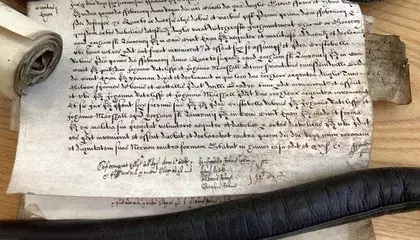
The exact details surrounding the theft of a purse nearly 400 years ago in Exeter, England, are still murky. Surviving evidence from 1642 suggests that it contained 13 shillings and one sixpence when it was taken. A woman named Anne King, the wife of a local weaver, was hired to track down its whereabouts.
King’s sleuthing methods were unorthodox. With a sieve and a pair of shears, she whispered the names of several possible perpetrators. The sieve rotated only when one specific name was uttered—that of Marie Matthews—leading King to mark her as guilty.
In a dramatic twist of fate, however, King herself was reported, arrested and put on trial for witchcraft. She was eventually released on bail and likely escaped with a warning. By the 1640s, while witchcraft prosecutions were increasingly rare in most of England, Exeter had a reputation for being particularly intolerant of all kinds of magic.
It continued executions for witchcraft into the 1680s. New research into cases like King’s suggests that Exeter was abnormally hostile even to so-called “service magicians,” or “cunning folk,” who used magic for relatively benign purposes, like finding lost goods or investigating petty crimes. Across most of England, service magicians went about their business while authorities turned a blind eye.
But King’s story is not standalone in Exeter, according to Stoyle’s new archival research, which combines centuries-old court records, manuscripts, birth and death certificates and other primary accounts to reveal Exeter’s unusually hostile views toward magic in the 16th and 17th centuries. Stoyle also highlights the case of Christabel Robyns, a widow who in 1629 was tried for witchcraft after using magic to find missing spoons and a pewter jug. Robyns was only saved by the intervention of the chief justice of the Court of the King’s Bench, a high-ranking legal official who referred her case to a higher court, away from Exeter.
It was the last place in England to execute people for witchcraft and local Justices of the Peace took a hard line against accused individuals, including the relatively benign service magicians.” Tens of thousands of people throughout Europe were killed for practicing witchcraft from the 1400s through the 1700s. In England, a majority of these victims were women, a phenomenon that some scholars have explained by the predominance of women in occupations—including as cunning folk—that that left them exposed to accusations of witchcraft. Women tended to work in community settings, unlike men, who worked in fields or workshops.
Extract — continue reading at the source.