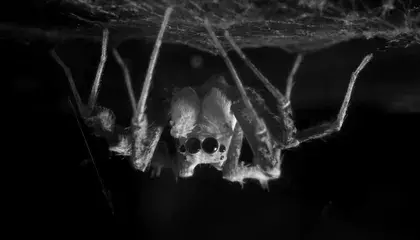
By filming one species’ nighttime routine—and attempting to disrupt it—researchers have identified that it enters two different sleep stages, including one resembling the phase linked to dreaming in humans. The work, published on October 26 in the Proceedings of the National Academy of Sciences, marks the first comprehensive confirmation of sleep behavior in spiders. The findings can help scientists unravel how snoozing evolved in animals.
Study co-author Daniela Rössler, an ecologist at the University of Bonn in Germany, first encountered this spider behavior in 2020. Pandemic restrictions kept her away from her lab, so she caught local jumping spiders of the species Evarcha arcuata and kept them in transparent boxes by her windowsill, Betsy Mason reported for Scientific American in 2022. One day, she noticed something strange—the spiders were all hanging motionless from silk lines hanging from the lids of their boxes.
That discovery led to a paper published in 2022 that suggested E. arcuata entered a stage akin to rapid-eye movement (REM) sleep. In humans, the brain becomes more active during this stage compared with other sleep phases, and we often dream. However, Rössler and colleagues hadn’t proven that the spiders were, in fact, snoozing.
To answer that question, the researchers recorded another species of jumping spider, called Portia fimbriata, with infrared cameras. Continuous recordings revealed that the spiders acted differently during the daytime compared with nighttime. When the sun was up, the arachnids were often stationary but actively monitored their surroundings.
They turned, scanned their environment and changed their posture in response to visual stimuli. But when the sun started to set, their behavior changed. They started to look for a place to rest—usually a silk platform they hang upside-down from—and spent time grooming themselves.
Eventually, they dozed off, drooping over the course of the night. This phase, which the researchers call quiescence, was interspersed with short bouts marked by twitching, leg curling and rapid eye movement—signs of REM-like sleep. Jellyfish and sea anemones sleep too In January, researchers reported that jellyfish and sea anemones spend about one-third of their day asleep, just like humans.
Extract — continue reading at the source.