At the start of the 20th century, we were still figuring out what the structure of matter was. We knew everything was made up of atoms, and that there were negatively charged electrons within them, but the rest of the atom was a mystery. Over the course of the past 125 years, we subsequently learned that there was a small, massive, positively charged nucleus anchoring every atom.
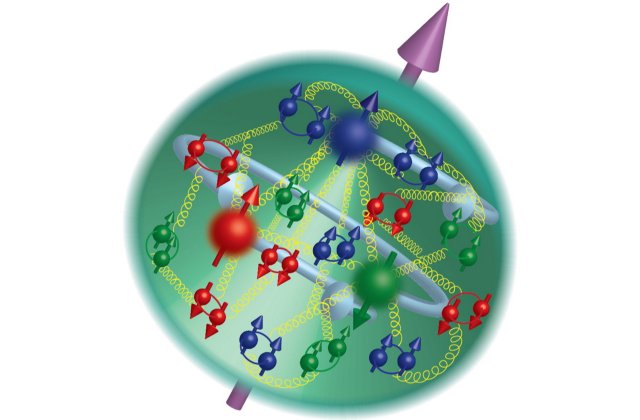
That nucleus itself is composed of nucleons — protons and neutrons — with each one itself made up of quarks and gluons. Protons consist of two up and one down quark apiece, while neutrons are made of two down and one up quark. But there are four other fundamental types of quark: strange, charm, bottom, and top, with the latter three all heavier than the proton itself.
How would it be possible, then, for such a particle, one more massive than the proton, to be found _inside_ of a proton? That’s what our Patreon supporter Aaron Weiss wants to know, asking: “[H]ow can there be charm quarks in protons? I thought charm quarks were more massive than protons, so how is this possible?
What does it mean that ‘heavy quarks also exist as a part of the proton wavefunction’ as [stated in this paper]?” It’s a deep question that makes us fundamentally reconsider how matter behaves on the tiniest scales. From macroscopic scales down to subatomic ones, the sizes of the fundamental particles play only a small role in determining the sizes of composite structures. Whether the building blocks are truly fundamental and/or point-like particles is still not known, but we do understand the Universe from large, cosmic scales down to tiny, subatomic ones.
The scale of electrons, quarks, and gluons is the limit to how far we’ve ever probed nature: down to scales of ~10^-19 meters, where these structures remain point-like. At an elementary level, we understand that everything that exists in the Universe is composed of fundamental, indivisible quanta: particles that obey the bizarre and often counterintuitive rules of quantum physics. The normal matter we’re familiar with is made out of atoms, which themselves are made out of nuclei and electrons, with nuclei composed of protons and neutrons, each of which has their own unique internal structure.
When most of us think about the internal structure of a proton or neutron, we think about the three quarks that determine their properties like electric charge, their magnetic moments, their masses, and more. The lightest particles are always the most stable, as heavier particles can decay to lighter ones; hence it’s no surprise that the normal matter we’re familiar with is made of the lightest two quarks: up and down. Get the fall print issue, shipping in October, to members only.
Extract — continue reading at the source.