Out there in the Universe, there are some incredibly impressive astrophysical entities, including behemoths that dwarf anything we’re familiar with. There are stars hundreds of times more massive, and millions of times as luminous, as our own Sun is. There are galaxies and galaxy clusters thousands of times as massive as our Milky Way and Local Group.
And there are black holes out there that not only dwarf our own Sun, but black holes that are so massive, they’re comparable in mass to all of the stars in the Milky Way galaxy combined. Some of them, quite puzzlingly, at first glance, even exist extremely early on in cosmic history: just a few billion years after the hot Big Bang first began. At those extremes, the largest black holes pose a number of important cosmic questions.
How did they grow so big so fast? Can physics even account for the highest-mass ones? And why do we see the biggest ones at such great distances, rather than close by?
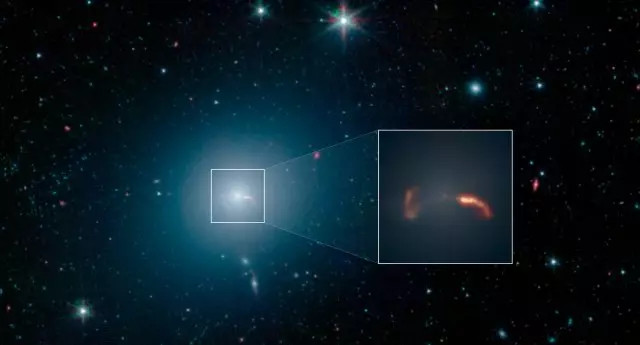
Is there something missing in our understanding? These questions, among others, inspired Eric Trant to write in and ask about TON 618: the black hole that first challenged our conventional understanding of how these supermassive black holes form and grow up in our Universe. Seeing as we’re incredibly far away, observing it as it was 10.8 billion years ago… how did it grow to be so large when it’s only [been] 3 billion years [since] the universe itself [began]?
It also seems odd that we don’t see more of similar size, closer to home?” The supermassive black holes that we know of pose many mysteries, and TON 618 is the one that kicked off our current series of questions. Here’s the story of how we got to where we are today. This set of illustrations explains how a large black hole can form from the direct collapse of a massive cloud of gas within a couple of hundred million years after the Big Bang.
Streams of gas, if they’re sufficiently cold, can lead to the direct collapse of a “seed” black hole of several tens of thousands (at least) of solar masses, which can form even prior to any stars forming in the surrounding young galaxy. As the galaxy and black hole grow, eventually the stellar mass content will outweigh the more slowly-growing black hole. Dark matter, which can’t become “cold” by shedding heat in the same way, can’t form a black hole similarly.
Extract — continue reading at the source.