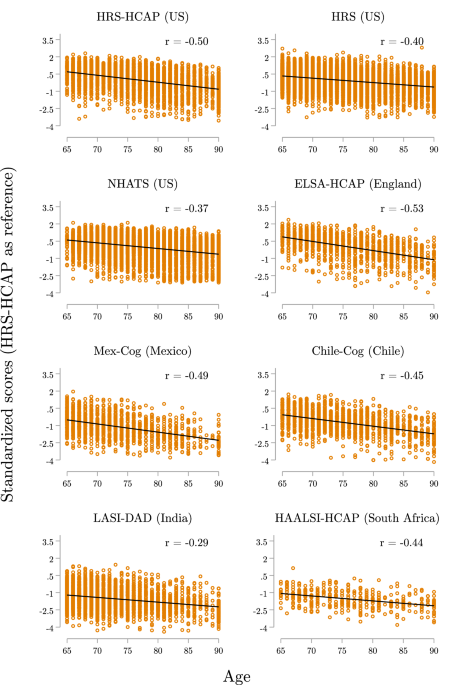
Harmonized cognitive measures are key to cross-national comparisons of dementia risk. However, validating such measures cross-nationally is challenging due to differences in cognitive measures and a lack of a reference standard. Age, a characteristic strongly associated with cognition and widely measured, can serve as a benchmark for evaluating how well harmonized cognitive measures are broadly compatible with a common construct.
We used cross-nationally harmonized measures from three studies in the US and five studies in England, Chile, Mexico, India, and South Africa (N = 27,317). Study-specific estimates of the association between general cognitive scores and age ranged from −0.040 to −0.075 SD units/year of age. The coefficient of variation was 24.1%, indicating moderate relative variability.
Results support the hypothesis that cross-nationally harmonized scores, derived from partially overlapping test batteries, measure a broadly similar construct across countries. Future studies should further evaluate criterion, construct, and content validity of cognitive testing in cross-national populations. The projected rise in the number of dementia cases1 poses challenges for quality of life, clinical care, and public health policy, especially in countries where the proportion of older adults is rapidly growing2.
Of the 152 million older adults projected to be living with dementia by 2050, 75% will be living in low- and middle-income countries (LMICs)3, where healthcare and other systems are presently unprepared to meet the complex cognitive needs associated with this demographic transition4. Neuropsychological assessments of cognitive function are essential tools for the characterization of the cognitive status and dementia risk of older adults5,6. However, the measurement of cognitive function can be affected by linguistic, cultural, social, and educational contextual factors7,8,9, underscoring a critical need to adopt or adapt, assess, and validate cognitive assessment tools that are appropriate across diverse global contexts9.
Most existing tools have been developed and validated in high-income countries, posing challenges for cross-national comparability and equitable diagnosis in LMICs7. The Harmonized Cognitive Assessment Protocol (HCAP) is intended to be a cross-nationally comparable, flexible battery of cognitive tests designed to enable researchers to harmonize data on cognitive measures and their risk factors across diverse contexts8,10. It is currently implemented in 18 countries7, and general and domain-specific cognitive scores have been statistically cocalibrated cross-nationally among countries whose HCAP data are publicly released8.
These scores are constructed from different test batteries with partially overlapping items, leveraging an item-banking approach to harmonization using item response theory methods. Cross-nationally harmonized cognitive measures are useful in furthering insights into the global etiology of dementia7. For example, differences across countries in cognitive functioning can generate new hypotheses about the determinants of dementia.
Extract — continue reading at the source.


