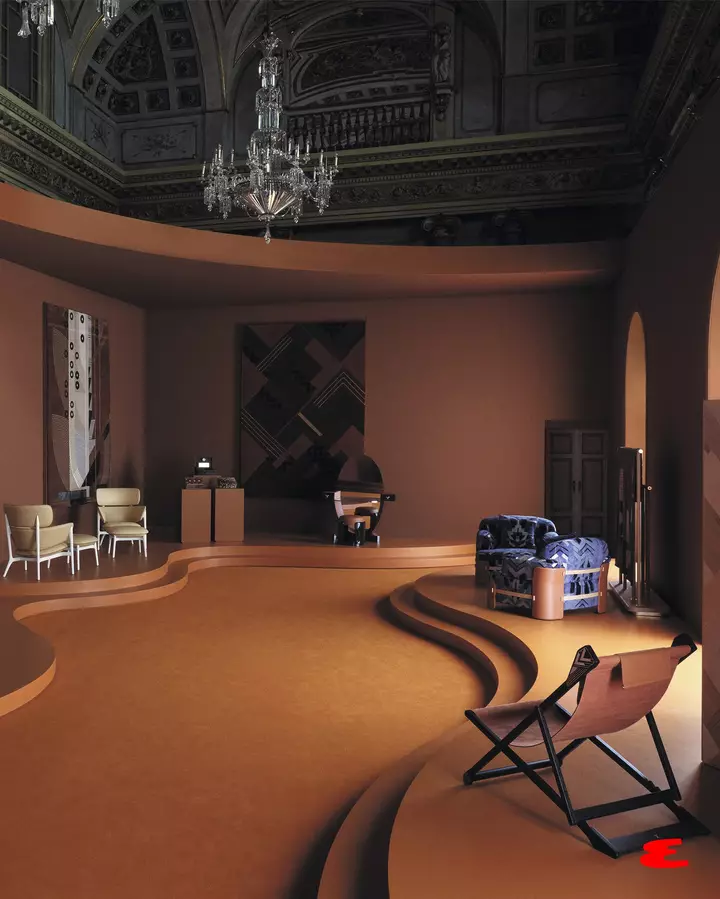
Louis Vuitton is no dilettante in the world of interior design and furnishings. Its Objets Nomades collection—featuring one-off and made-to-order marvels created by leading contemporary designers, as well as tableware and textiles—debuted in 2012, but its roots in the home sector reach back more than 100 years to a period rich in architectural and aesthetic innovation. We’re talking about art deco, the thoroughly avant-garde design philosophy that exploded into the world of taste at the 1925 Exposition Internationale des Arts Décoratifs et Industriels Modernes in Paris.
And to mark the centenary of this most French of movements, the brand decided to devote much of its new Objets Nomades offering to Parisian artist and craftsman Pierre Legrain, an early deco proponent and a close collaborator of Vuitton’s. Art deco, which drew its name directly from that 1925 exhibit, was inspired by diverse artistic and industrial movements that emerged in the first quarter of the 20th century. Drawing on everything from futurism and cubism to the mechanized revolutions in aviation and automotives, it was all about the future.
For a brand like Vuitton, rooted in the glamour of travel, this brave new world was a good place to be—and one in which the Vuitton family moved easily. At the time, the maison’s horizons were expanding well beyond the luggage that was its initial raison d’être. That’s thanks to Gaston-Louis Vuitton, the grandson of the brand’s eponymous founder.
A polymath designer, collector, and inventor, Gaston added accessories, objects, and furniture to the LV wheelhouse during the ’20s, much of it shown at that fateful exhibition in 1925. Even ahead of that, he had tapped Pierre Legrain in 1921 to create the brand’s first piece of furniture for a Vuitton client: a lacquered red-and-blackomega-shaped dressing table that was through and through deco in its curvilinear starkness. Legrain’s was a world in which every craft discipline bled easily into others.
Working in marquetry, bookbinding, and illustration—including advertising materials and drawings for Vuitton as early as 1910—he set the tone for the deco movement before it had a name. And he remains one of its powerhouse figures, despite his death at just 39 years old in 1929. Fast-forward to 2026 and it was Legrain whom Louis Vuitton turned to once again.
For its Pierre Legrain Homage collection, which debuted at Milan’s Salone del Mobile, Vuitton worked with the approval of Legrain’s family to reimagine some of his boldest designs in furniture, textiles, ceramics, and glass. Motifs from bookbinding and marquetry can be found in geometric throws and double-faced cashmere blankets that would look as comfortable mounted on an apartment wall as they would draped over a sofa. And calling on the artisanal skills of hundreds of experts in these fields, the house also re-created some key made-to-order pieces from Legrain himself, including the dressing table from 1921, a folding marquetry screen, and a Riviera Chilienne chair (essentially a deck chair with delusions of grandeur, made from oak and leather with a mother-of-pearl inlay).
Extract — continue reading at the source.