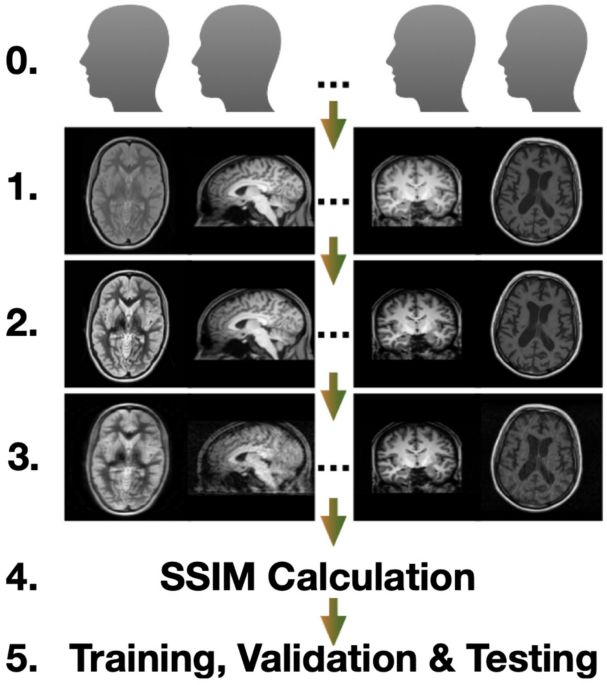
The assessment of MR image quality is fundamental before proceeding with the clinical diagnosis. Motion artefacts can alter the delineation of structures such as the brain, lesions or tumours and may require a repeat scan. Otherwise, an inaccurate (e.g. correct pathology but wrong severity) or incorrect diagnosis (e.g. wrong pathology) may occur.
An automated image quality assessment based on the structural similarity index (SSIM) regression through a residual neural network is proposed in this work. Additionally, a classification into different groups - by subdividing with SSIM ranges - is evaluated. Importantly, this method predicts SSIM values of an input image in the absence of a reference ground truth image.
The networks were able to detect motion artefacts, and the best performance for the regression and classification task has always been achieved with ResNet-18 with contrast augmentation. The mean and standard deviation of residuals’ distribution were \(\mu =-0.0009\) and \(\sigma =0.0139\), respectively. Whilst for the classification task in 3, 5 and 10 classes, the best accuracies were 97, 95 and 89%, respectively.
The results show that the proposed method could be a tool for supporting neuro-radiologists and radiographers in evaluating image quality quickly. Image quality assessment (IQA) is a fundamental tool for evaluating MR images1,2,3. The main purpose of this process is to determine if the images are diagnostically reliable and free from critical artefacts4,5.
Often the evaluation process requires time and is also subjectively dependent upon the observer6. Furthermore, different levels of expertise and experience of the readers (experts designated to perform the IQA) could lead to variable assessment results. Another intrinsic issue of the IQA for MR images is the absence of a reference image.
Reference-free IQA techniques with and without the machine and deep learning support have been proposed in the last years for the evaluation of the visual image quality3,4,7,8,9,10,11,12,13,14. These techniques are able to detect and quantify the level of blurriness or corruption with different levels of accuracy and precision. However, there are many factors to take into consideration when choosing which technique to apply; the most important are15,16,17: data requirement - as deep learning requires a large dataset while traditional machine learning (non-deep learning based) techniques can be trained on smaller data sets; accuracy - deep learning provides higher accuracy than traditional machine learning; training time - deep learning takes longer time than traditional machine learning; hyperparameter tuning - deep learning can be tuned in various different ways, and it is not always possible to find the best parameters, while machine learning offers limited tuning capabilities.
Extract — continue reading at the source.