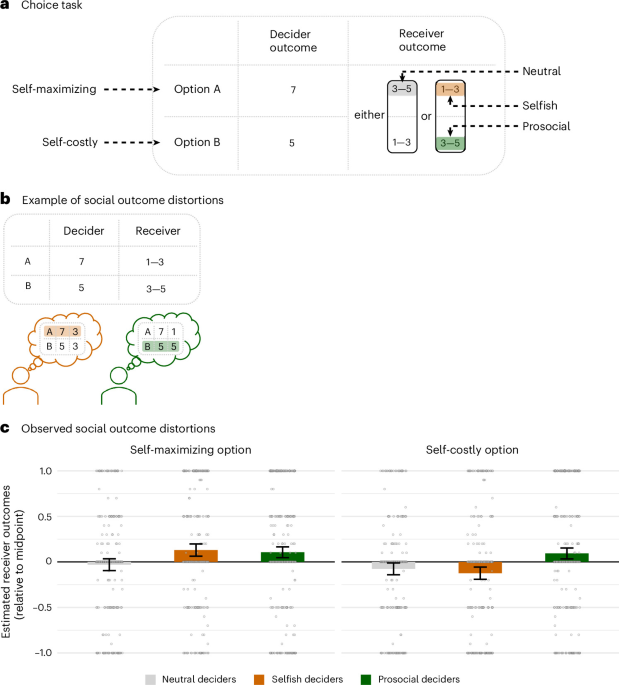
People often act without knowing exactly how their actions impact others. Here, across nine preregistered online experiments (N = 8,769 adults, predominantly US residents), we tested whether people exploit this ambiguity to make themselves look good. On average, selfish individuals inflated the social benefit of their choice while downplaying that of the alternative, reporting the two options as more similar than prosocial individuals did (experiment 1a: b = 0.24, 95% confidence interval 0.14–0.34).
Prosocial individuals portrayed their choice as comparatively more socially beneficial; they also inflated their implied relative sacrifice, although less consistently. We observed distortions even before people made a choice and when choices were forced, consistent with distortions reflecting social preferences rather than mere justification. While people differed in whether and how they distorted, distortions favouring selfishness showed evidence of contagion: others adopted them and became more selfish (experiment 6, selfish-serving versus no-distortion: b = 0.49, 95% confidence interval 0.10–0.88).
These findings offer a psychological foundation for why polarized positions about the social impact of one’s actions may emerge. When social consequences are open to interpretation, people may predictably form divergent interpretations. Choices usually carry social consequences.
Whether we buy clothing produced under poor labour conditions or spend money on vacation instead of donating to charity, choices almost always entail social opportunity costs. Policymakers, too, face decisions with substantial implications for others, such as whether to fund science and social programmes or cut taxes. People differ in the extent to which they factor in the social and environmental consequences of their actions, balancing self-interest with the impact their choices have on others1,2,3.
Yet, personal and social outcomes are fundamentally imbalanced: while personal outcomes are usually immediate, tangible and directly experienced, the consequences for others often remain ambiguous and difficult to assess. The benefits of going on vacation, for example, can be felt directly, but the impact on others or the environment often remains distant, uncertain and open to interpretation. Consider the case of two researchers travelling to a conference: one by plane, the other by train.
Both may recognize that their choice carries environmental and thus social consequences, yet neither can easily quantify its precise impact. This raises a fundamental question: How do people interpret the ambiguous social consequences of their actions? People may choose different actions depending on how much they value the social consequences, but they would ideally still share a common understanding of what those consequences are.
Extract — continue reading at the source.