Eurasia is becoming less about distance and more about connection, where trade routes are expanding, supply chains are being redirected, and countries that once dealt with each other mainly through diplomacy are increasingly connected by investment, transport, energy and technology. The Shanghai Cooperation Organization (SCO), which marks its 25th anniversary this year, is one of the clearest examples of this shift. The organization's role for Azerbaijan as an SCO partner is increasingly practical rather than symbolic, as the relationship now covers security, trade, investment, energy, transport, telecommunications, agriculture, education and culture.
These are the areas that increasingly overlap as Eurasian economies become more interconnected. The scale of the organization alone explains why it matters. The SCO brings together 10 member states, including China, India, Russia, Iran, Pakistan and the Central Asian countries, representing roughly 40% of the world’s population and a substantial share of global economic activity.
Therefore, for Baku, access to such a network creates opportunities well beyond traditional bilateral relations. Moreover, Azerbaijan’s geographical position gives it particular relevance to the SCO’s growing economic network. As the country sits on the western shore of the Caspian Sea, linking Central Asia with Türkiye and European markets, its transport infrastructure is becoming increasingly important to this role.
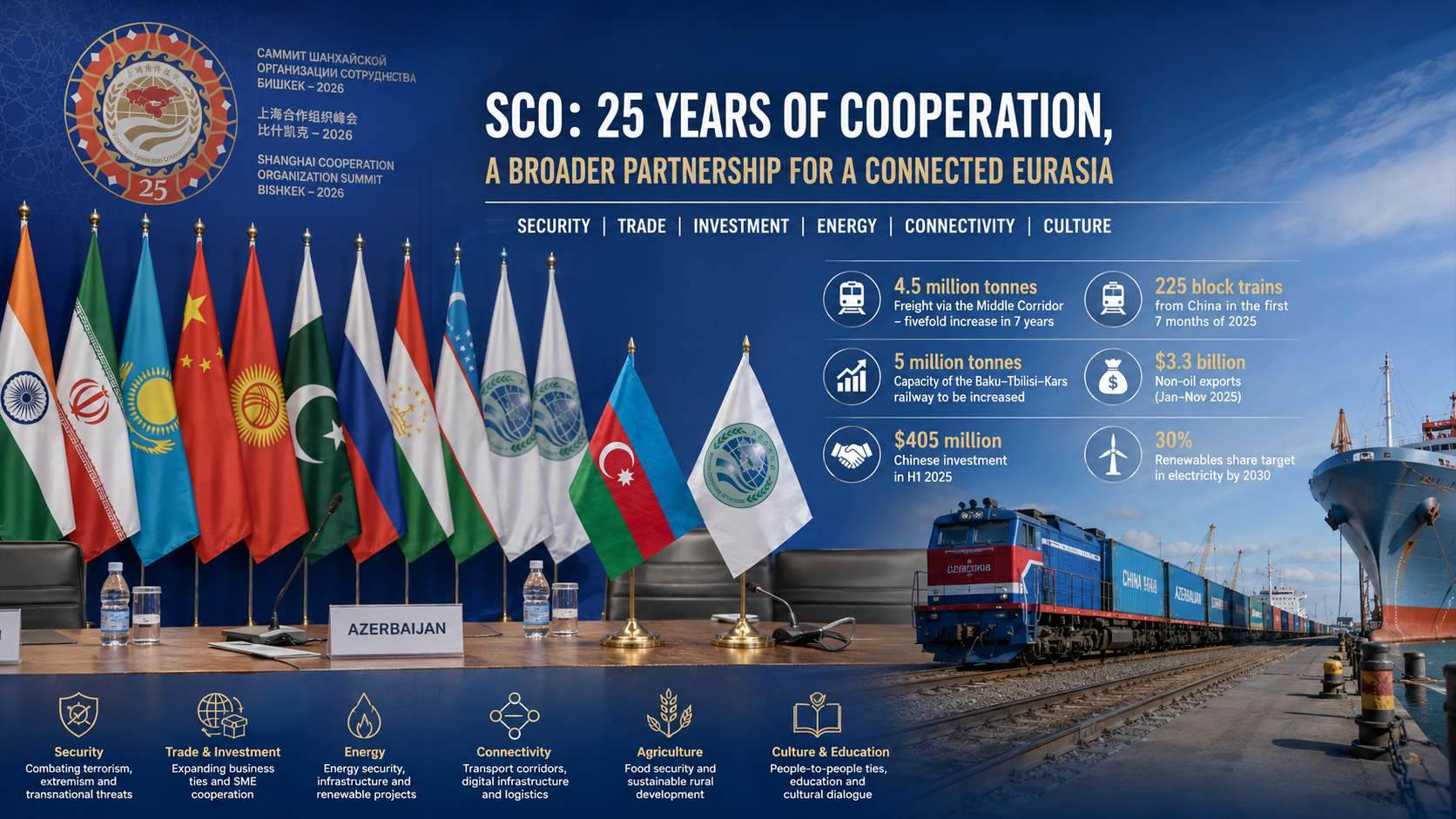
It is significant to note that the Middle Corridor, connecting China and Central Asia with the Caucasus and Europe through the Caspian Sea, has seen rapid growth. Freight volumes along the route have increased roughly fivefold in seven years, reaching around 4.5 million tonnes. In the first seven months of 2025 alone, 225 block trains from China travelled through the corridor.
Infrastructure investment is following the demand. The capacity of the Baku–Tbilisi–Kars railway is being increased from about 1 million tonnes to 5 million tonnes a year, while Azerbaijan’s railway operator ADY has purchased 300 new wagons. These numbers show more than transport statistics by portraying how Azerbaijan can turn geography into an economic asset.
And the same logic applies to trade and investment. Azerbaijan’s non-oil exports reached about $3.3 billion in January–November 2025, accounting for roughly 14% of total exports. At the same time, Chinese investment in Azerbaijan reached approximately $405 million in the first half of 2025.
Extract — continue reading at the source.