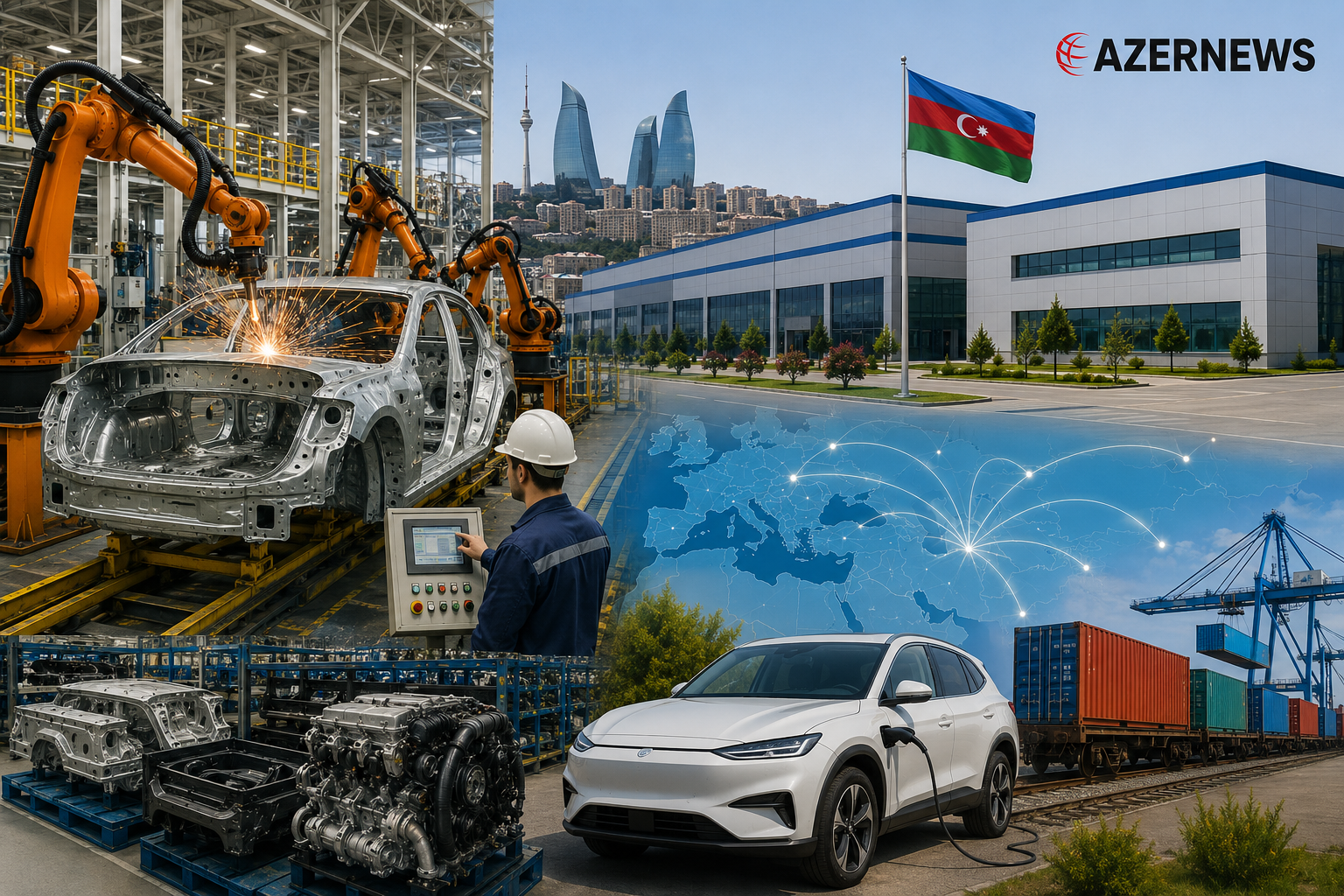
It would be fair to say that when you think about Azerbaijan, you would rarely think about the capacity of its automobile industry - and maybe it would be the last thing to come to mind. Yet beneath this low profile, a deliberate structural shift is underway. Baku is moving beyond simple resource extraction and is beginning to see vehicle manufacturing as an opportunity to test out non-oil industries, adaptation to technology, and value-added manufacturing.
Although the industry is still a fraction of the size of established auto manufacturers, it is being subtly realigned as a meeting point between local supply chains, tax-favored industrial zones, and the global shift to electric transportation. At roughly the same moment, Azerbaijani officials confirmed that a joint Azerbaijani-Uzbek enterprise in the Hajigabul Industrial District was completing preparatory work on an $84.3 million full-cycle automotive plant (surge of 88.4%), with production line orders placed and a mid-2027 commissioning target set. The worldwide automobile industry is not experiencing just a cycle of downturn in its traditional strongholds; rather, it is experiencing geographical reorganization, and the locations where manufacturing capacities are being built are not always those expected from the industry's map of the twentieth century.
The problems of the automotive industry following the pandemic were first correctly identified as a supply chain issue. However, that understanding was far from being comprehensive. The supply chain problem only made clear the structural flaw that has been brewing for decades, namely, that the manufacturers in Europe, America, and Japan have designed their production systems based on the stable trading order which no longer exists.
Expensive labor, high taxation, dependence on energy prices, and expensive transformation to electric vehicles make European automotive manufacturing less and less competitive compared to Chinese manufacturers who have created their own advantages from scratch over the last decade. In the whole case, what is important is China’s position. For example, in 2025, China produced about 34.53 million cars, which accounted for 39% of the total global production, while in the first half of 2026, about 3.38 million cars were exported by China, which is 48% higher than in the same period of time last year.
The predictions are that annual Chinese exports will reach 10 million in the course of one-two years. The consequences of such an export development for other car manufacturers can be either positive or negative. On the one hand, owing to the presence of cheap Chinese cars in developing countries, it is becoming harder to attract customers.
On the other hand, there is a place for those manufacturers that have the advantage of being close and that produce certain types of products that have never interested Chinese manufacturers. The difference between semi-knocked down (SKD) assembly and completely knocked down (CKD) manufacturing is technically described but economically revolutionary. SKD assembling entails bringing assembled parts of the car from abroad, assembling them, and selling the product – creating jobs and generating some economic activity, but providing little economic depth because the added value remains in the home country, and the assembler is necessarily dependent on an outside supply chain beyond its control.
Extract — continue reading at the source.