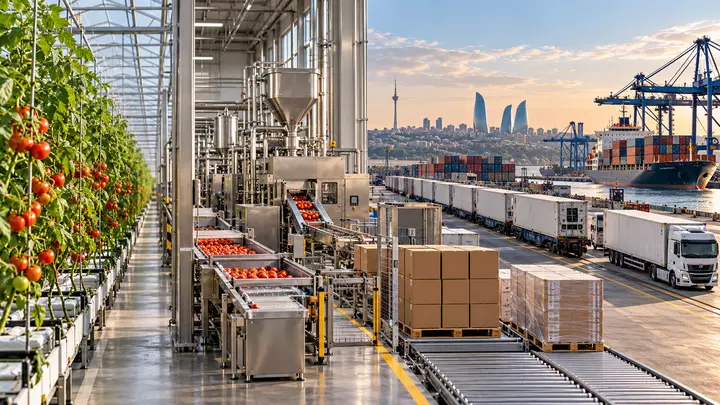
Every summer, refrigerated trucks and rail containers leave Azerbaijan's orchards and greenhouses for the north. Between January and September this year, they carried 563,300 tonnes of fresh fruit and vegetables worth $671.4m, 11.4% more than in the same period of 2025, according to the State Customs Committee. Last year, total exports were 846,000 tons valued at $901.5 million.
Given the efforts of Baku for decades in developing an oil-free sector, it is considered to be a success story. But its geography needs closer inspection. Russia took 83.1% of the value of Azerbaijani fruit and vegetable exports in the first eight months of 2026, some $529.5m of the $637.1m shipped, according to the agriculture ministry.
The rest of the top five is quite tiny by comparison: Italy (4.3%, largely hazelnuts), Germany (2.7%), Belarus (2.2%) and Georgia (1.6%). For tomatoes, the concentration is starker still. In some recent years, nearly all of Azerbaijan's tomato exports have gone to Russia, and shipments there this year reached 134,500 tonnes worth $160.8m.
All of this is not irrational at all, and in fact, there is no issue with exporting goods to Russia, since the Russians have been dealing with Azerbaijani produce for years and the logistics are well-known, not to mention that the harvest schedule coincides with the needs of Russia. Fruits and vegetables constituted a fourth of Azerbaijan's key exports outside of oil in 2025, which earned Russia about $696m worth, up 30 percent from last year. However, dependence comes with a price tag.
In the past summer season, an organization representing Azerbaijan’s exporters claimed that Rosselkhoznadzor, Russia’s plant safety authority, was placing “artificial barriers” for tomato pest inspections. While the exports were not banned and proceeded despite additional costs and delays, there are some lessons to be learned from the case. Armenian producers may recall how fast agriculture legislation turned into political instruments in May-June 2019 due to temporary import bans on their products.
Azerbaijani-Russian bilateral trade has decreased by about 25% over the year, despite good results in farm exports. 83% of export volumes should not depend on the discretion of a single buyer. One of the few things that Azerbaijan needs is diversification, recognizing that Russia is always present on our border. However, establishing and adding contacts with different countries will benefit Azerbaijan not only in the agricultural sector but also in many other aspects.
Extract — continue reading at the source.