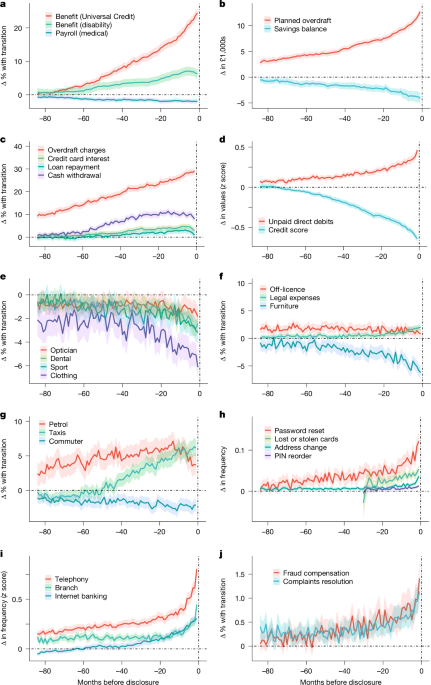
The experience of financial abuse, a form of domestic abuse involving control over money and finances, can be severe and long-lasting1,2,3, yet difficult to document4. Evidence on the everyday experiences of victim-survivors in the context of financial abuse is drawn primarily from small-scale, qualitative surveys5,6. Using anonymized banking data from a major UK retail bank, we compared the financial outcomes of a group of female victim-survivors of financial abuse (n = 5,428; identified from customer disclosures to the bank) with a control group (n = 15,602; consisting of individuals with no known disclosures).
The control group matched the demographic and socioeconomic characteristics of the victim-survivor group 7 years before disclosure. A comprehensive set of 373 transactional and non-transactional financial outcomes were analysed over this period. Results indicate that, compared with controls, victim-survivors exhibited depleting savings and increasing debts, culminating in missed payments and declining credit scores.
They also spent less on self-care, incurred higher transport and legal costs, increased cash withdrawals, changed addresses and passwords more frequently and were more likely to claim welfare benefits. Our results demonstrate how victim-survivors lose financial independence, experience economic instability and suffer financial distress. Domestic abuse is increasingly recognized as an important public health concern worldwide7.
In the United Kingdom, the Domestic Abuse Act 2021 (ref. 8) provides a broad definition encompassing psychological, physical, sexual and economic abuse between people with personal connections (for example, family or intimate partners). In England and Wales, an estimated 12.6 million people have experienced domestic abuse, with women disproportionately affected (30% compared with 22%; ref. 9). The annual cost is estimated at £66 billion (ref. 10) (2017 prices; £91 billion in 2026 prices11), largely because of harm, lost productivity and health care costs.
Although research on domestic abuse has mostly focused on physical violence12, many scholars stress that violence must be understood within the wider context of coercive control13,14, which can also encompass psychological, sexual, economic and financial abuse. The terms ‘economic’ and ‘financial’ abuse are often used interchangeably in the literature, but while economic abuse is broadly defined as control over economic resources, financial abuse specifically focuses on control over money and finances15. Financial abuse can include restricting access to money (for example, controlling bank accounts or rationing cash), exploiting the victim for financial gain (for example, coercing welfare claims or accruing debt in their name) or sabotaging their finances (for example, preventing work or damaging credit rating)16.
Financial abuse is often intertwined with other aspects of coercive control (for example, emotional, sexual or physical abuse)3, reflecting a broader constellation of harms that may include stress, injury, reduced work capacity, social isolation and poorer financial well-being. It is estimated that 97% of all domestic abuse cases also involve some form of economic abuse, and that in 57% of cases the victim-survivor is coerced into debt17. Survey data from victim-survivors show an average individual debt of £32,000 (ref. 17), and an overall £14.4 billion of debt in the United Kingdom is estimated to be related to economic abuse3 (2020 prices; £18.78 billion in 2026 prices11).
Extract — continue reading at the source.