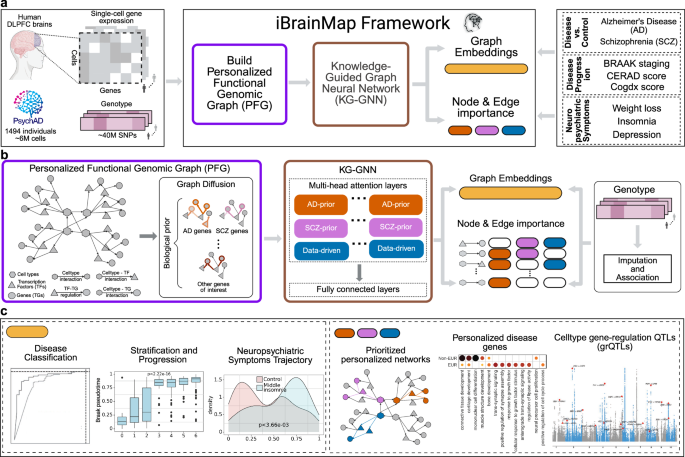
Alzheimer’s disease (AD) is highly heterogeneous and driven by diverse molecular and cellular mechanisms. Functional genomics investigates these mechanisms from genetic variants to gene expression and regulation. We performed personalized functional genomics analysis on population-scale single-nucleus RNA-seq data, with cross-cohort validation across multiple cohorts comprising over 1900 individual brains, capturing donor-level cell type interactions and gene regulatory networks.
Using a knowledge-guided graph neural network, we learned latent representations of each donor’s functional genomics that accurately classified AD phenotypes, identified molecularly defined subpopulations, and traced disease progression trajectories. Our importance scores, derived from graph attentions, identified significant inter-donor differences and prioritized personalized cell type genes and regulatory networks. Finally, we identified gene regulatory QTLs (grQTLs) linking genetic variants to donor-level regulatory changes, providing insights into gene regulatory relationships beyond traditional eQTLs.
All results are summarized into a personalized functional genomics atlas for AD, including an open-source framework, iBrainMap, for general use. The human brain exhibits higher transcriptomic complexity than most other tissues1,2, making it susceptible to a wide range of neurodegenerative and neuropsychiatric diseases. These diseases are heterogeneous, with a broad spectrum of symptoms, varying severity levels, and phenotypic differences3,4 that stem from diverse cellular and molecular mechanisms5,6.
In the context of Alzheimer’s disease (AD), large-scale single-cell RNA-seq datasets across individuals (e.g., ROSMAP7,8 and SEA-AD9) have led to the study of gene expression variation at the cell type (CT) level7,8,10. These studies have expanded beyond binary case-control comparisons by incorporating detailed AD phenotypic stratification (e.g., resilience, pathology-cognition) and individual-level metrics. Complementing these studies, functional genomics has emerged to investigate gene regulatory mechanisms, linking genetic variants to changes in gene expression and downstream cellular functions underlying these diseases2,11,12.
For instance, gene regulatory networks (GRNs), which can model interactions between genes (transcription factor to target genes) at a CT level, have identified key genes and functions associated with AD phenotypes13,14,15. Similarly, several population studies have shown that cell–cell communication is an essential component in AD (e.g., via CT interactions, such as astrocyte-microglia crosstalk in β-amyloid pathology16 and neuroinflammation17). However, how these interactions vary between individuals remains unclear.
While many studies have pooled cells across individuals to identify regulatory mechanisms, fewer have aimed to construct individualized functional genomic models for AD. Here, we define “personalized functional genomics” as the modeling of cell type interactions and gene regulatory networks at the individual donor level, informed by each donor’s single-cell transcriptomic profile and known disease-related priors. Large amounts of individual data are essential to capture the complexity and variability of functional genomics present across populations in AD.
Extract — continue reading at the source.