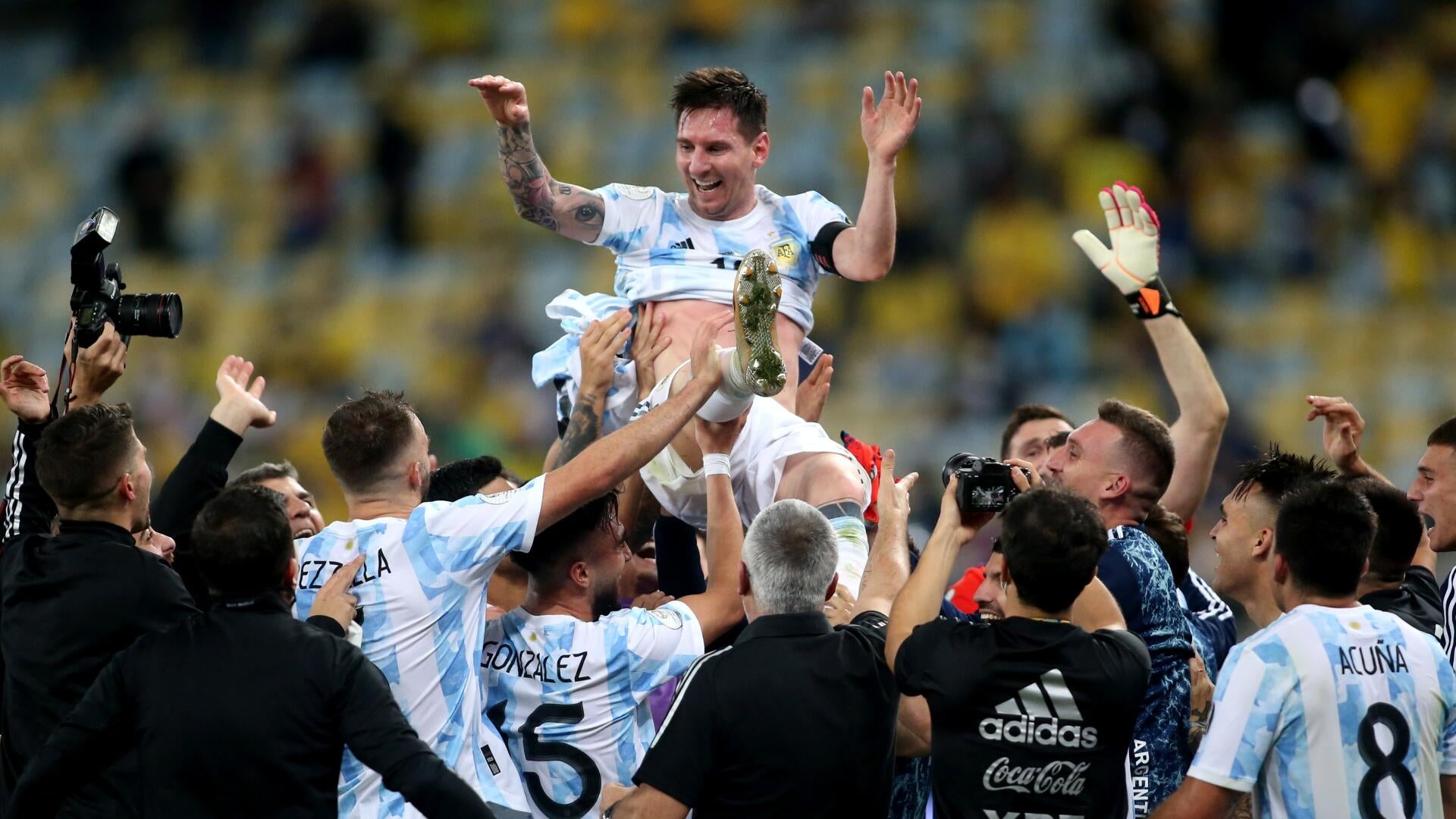
At first glance, Lionel Messi's legacy with Argentina runs the risk of being unimaginably obvious. The national team's most iconic player would naturally end his decades-long international career as the all-time appearance leader and greatest-ever goalscorer, all while boasting a World Cup and two Copa America titles to his name. The accolades are fitting for a player of his singular caliber, one who has earned the right to be universally adored and appreciated as he confirms his international retirement 21 years after first representing the national team.
The achievements, though, almost mask the complex nature of Messi's Argentina tenure. Messi's otherworldly ability with a soccer ball at his feet has never been in question, to the point that the lore of his unlikely journey to the top – his short stature, the contract signed on a napkin, the move to Barcelona in his teenage years – is so pervasive. His story with Argentina is a complex one, the road to his happy ending winding.
The majority of his 21 years with the national team came and went before he won his first major international title in 2021, those years instead marred by painful defeats and underwhelming results that Messi shouldered the blame for even if the fault was hardly his. It was an example in the emotion and passion, and ultimately the pressure, that is intertwined with embodying Argentina's storied national team all on his own. In his decades wearing Argentina's iconic light blue and white jersey, Messi likely experienced every feeling available in a business that is oftentimes reduced to ruthlessness and single-minded, emotionless conviction.
The title-winning moments that lined the final years of his international career will be the headlining acts, chief among them lifting the 2022 World Cup, but it came after sizable defeats that challenged a nation's unrelenting belief in him – and his own self-confidence. It was something Messi himself recognized in a handwritten note he penned two days after last month's World Cup final, refusing to skip over the fact that his national team journey was not an experience in going from strength to strength. "I swear I always gave everything, not only in these last few years when we won everything, but before that too," he wrote in part.
"I always fought and gave everything for this shirt, to bring you happiness and make you feel proud to be Argentine through football … Thank you for all the love during these 20 years. I'm going to miss hearing you from the inside. Now I'll be one of you, always supporting from the outside, in the good times and even more in the bad ones.
Thank you to my family for always being there and for being with me throughout this beautiful but difficult journey. Thank you to every coach, teammate and director I had the chance to share it with." These are the moments that marked Messi's Argentina career. There were signs that a straightforward international career was not waiting for Messi as soon as he made his Argentina debut in a 2-1 win at Hungary in 2005 – within 90 seconds, he was shown a red card for an elbow to the face of an opponent, a call that looks very soft on replay, a benefit referees did not have until more than a decade later.
Extract — continue reading at the source.