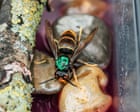
British beekeepers have called for a national awareness campaign about the impact of Asian hornets as they warned the invasive species was creating “pollinator deserts” and threatening food security. Native to south-east Asia, the yellow-legged hornet is thought to have arrived in Europe in 2004 and has continued to spread ever since, its numbers probably boosted by increasingly warm springs and summers. The end of summer is a crucial time in Britain’s fight against the species.
As colonies mature and nests reach maximum size, the hornets produce fertile new queens that will leave, mate and seek places to survive winter. The following spring, they establish new colonies, resulting in more nests across a wider geographical area. Asian hornets are an invasive species that prey on other insects.
But as well as threatening bees and making honey production difficult for beekeepers, the “real cost” of Asian hornets also concerned human safety, pollination and biodiversity, said Lucie Chaumeton, a trustee of the British Beekeepers Association (BBKA) and the vice-chair of its committee on the yellow-legged Asian hornet. The government has been aware of this threat to biodiversity since it completed a risk assessment in 2011, which prompted the Department for Environment, Food and Rural Affairs and the Welsh government to develop a contingency plan for dealing with the species. Britain’s strategy is based on destroying nests to prevent the hornets from becoming established.
Missing a single nest sustains an already established colony and risks the establishment of new colonies. One indication of the strategy’s effectiveness is the number of nests that are found. In 2025, the NBU destroyed a record 161 nests.
But there is still some evidence of establishment. Genetic analysis of nests found in 2024 confirmed that queens had successfully mated, survived winter and established new nests the next year. This means the period when queens emerge from hibernation is an important intervention point.
Apha said the public and beekeepers played a key role. Public sightings and reports are used to identify suspected hornets, while volunteer teams from the BBKA help confirm sightings, track nests and undertake spring queen-trapping. Once a nest is confirmed, the NBU is responsible for its destruction.
Extract — continue reading at the source.