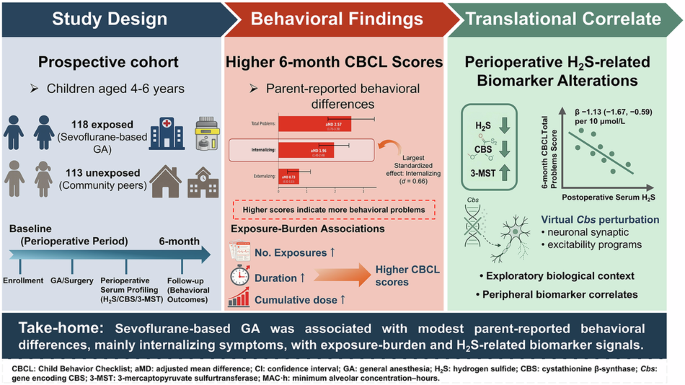
The association between general anesthesia (GA) for surgical procedures in preschool children and subsequent neurobehavioral outcomes remains unresolved, and human biomarker data on potential biological correlates are limited. We conducted a prospective cohort study of 118 preschool children undergoing surgical procedures requiring sevoflurane-based GA and 113 unexposed peers, with 6-month behavioral and neurocognitive follow-up and perioperative profiling of hydrogen sulfide (H2S)-related biomarkers. Compared with unexposed children, exposed children had modestly higher parent-reported CBCL behavioral problem scores, most prominently for internalizing symptoms, whereas executive-function and cognitive-screening differences were limited.
Within the exposed group, greater perioperative exposure burden, reflected by repeated anesthesia episodes, longer anesthesia duration, and higher cumulative sevoflurane dose, was associated with less favorable behavioral profiles. Serum H2S and cystathionine β-synthase (CBS) decreased postoperatively, whereas 3-mercaptopyruvate sulfurtransferase (3-MST) increased; lower postoperative H2S was associated with higher subsequent behavioral scores. Exploratory analysis of publicly available single-nucleus hippocampal data further suggested that virtual perturbation of Cbs, encoding CBS, converges on neuronal programs relevant to synaptic plasticity and excitability.
These findings suggest modest behavioral differences within a real-world sevoflurane-based perioperative context, with H2S-related biomarkers providing exploratory biological and mechanistic context. The authors would like to thank the study participants and staff for their valuable contribution to this research. This work was supported by the National Natural Science Foundation of China (Nos. 82271233 and 82571358 to Hui Zheng) and the Fundamental Research Funds for the Central Universities (No. 3332024046 to Qi Hou).
The funders had no role in the design of the study; the collection, management, analysis, or interpretation of the data; or the preparation, review, or approval of the manuscript. These authors contributed equally: Zhichao Li, Youzhuang Zhu, Xuanyuan Pan. Department of Anesthesiology, National Cancer Center/National Clinical Research Center for Cancer/Cancer Hospital, Chinese Academy of Medical Sciences and Peking Union Medical College, Beijing, China Zhichao Li, Shuai Li, Linhui Ma, Qing Xu, Qi Hou & Hui Zheng Department of Anesthesiology, Shandong Provincial Key Medical and Health Laboratory of Anesthesia and Brain Function, The Affiliated Hospital of Qingdao University, Qingdao, China Department of Anesthesiology, Shengjing Hospital of China Medical University/National Children’s Regional Medical Center, Northeast China, Shenyang, China Department of Anesthesiology, Plastic Surgery Hospital, Chinese Academy of Medical Sciences and Peking Union Medical College, Beijing, China Department of Cancer Prevention and Control, National Cancer Center/National Clinical Research Center for Cancer/Cancer Hospital, Chinese Academy of Medical Sciences and Peking Union Medical College, Beijing, China Office of Cancer Screening, National Cancer Center/National Clinical Research Center for Cancer/Cancer Hospital, Chinese Academy of Medical Sciences and Peking Union Medical College, Beijing, China Jiangsu Province Key Laboratory of Anesthesiology/NMPA Key Laboratory for Research and Evaluation of Narcotic and Psychotropic Drugs, Xuzhou Medical University, Xuzhou, China Department of Pediatric Rehabilitation, Women & Children’s Health Care Hospital of Linyi, Linyi, China Department of Pediatric Neurology, Shengjing Hospital of China Medical University, Shenyang, China Correspondence to Yuqing Wu, Jun Chai or Hui Zheng.
The authors declare no competing interests. This prospective study was approved by the Ethics Committee of Shengjing Hospital of China Medical University (Approval No. 2024PS1204K). The study was conducted in accordance with the Declaration of Helsinki.
Written informed consent for participation and for the collection and use of study data was obtained from the parent or legal guardian of each participant prior to enrollment. Publisher’s note Springer Nature remains neutral with regard to jurisdictional claims in published maps and institutional affiliations. Open Access This article is licensed under a Creative Commons Attribution-NonCommercial-NoDerivatives 4.0 International License, which permits any non-commercial use, sharing, distribution and reproduction in any medium or format, as long as you give appropriate credit to the original author(s) and the source, provide a link to the Creative Commons licence, and indicate if you modified the licensed material.
Extract — continue reading at the source.


