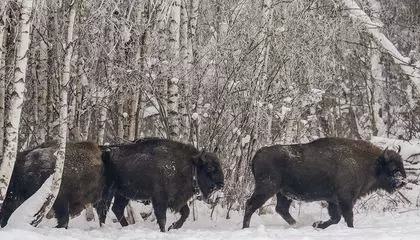
A branch snaps under Rafał Kowalczyk’s feet as he pushes through a tangle of trees, tracking a herd of wisents though a dense part of the Bialowieza Forest, a stretch of pristine lowland woods at the eastern edge of Poland. He can’t see the animals, but he can hear them: the grunting, the snorting. It’s quite warm for December, about 40 degrees Fahrenheit, and his rubber boots squelch against the boggy soil.
Kowalczyk hoped to study the animals’ herd structure and assess their health. An ecologist at the Polish Academy of Sciences, in his mid-50s and sporting an unshaven look of someone who spends a lot of time outdoors, he has been studying wisents in Bialowieza for more than 20 years. This time, however, he has to give up and turn back to his car.
The day before, I’d met a group of rangers in a different part of the forest, where the trees were more widely spaced. I saw several dozen bison there, and they were majestic. The European bison is a different species from the American one.
It’s lankier, taller, harder to tame. Some scientists think that the two species’ most recently shared ancestor lived in the Pleistocene era, before some ancient bison migrated across the Bering Strait and others wandered through Europe, mating with the ancestors of domestic cattle. Compared with its American cousins, the wisent has a smaller hump on its back, and its head sits higher.
As I stand watching the herd, a sound scares them off, and they run away with a surprising speed and agility, deeper into the forest. Kowalczyk first visited this area from central Poland many years ago. At the time, he wasn’t interested in studying wisents.
He remembers the train pulling into the town of Bialowieza, at the edge of the forest, close to midnight, snow piling so high against the station’s doors that they wouldn’t open. But then I saw the forest and I fell in love.” At first, Kowalczyk wanted to study wolves, lynx; the predators. Instead, his supervisors pushed him into a project on wisents.
Extract — continue reading at the source.