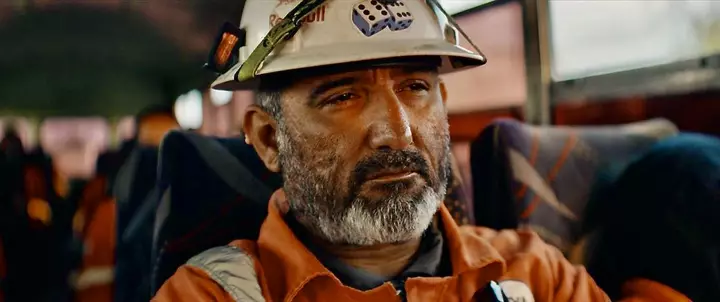
'Black Shine' marks Maza's follow-up to 'State of Silence,' a impactful passion project of Diego Luna, awarded Best Feature at Chile’s top festival, Sanfic in 2024 Mexico’s Santiago Maza, whose fourth feature-length doc “State of Silence,” (“Estado de Silencio”), a passion project of Diego Luna, snagged the best feature award at Chile’s 2024 Santiago Film Festival (Sanfic), has premiered his latest work, “Black Shine” (“El brillo negro”) at the Morelia Film Festival where it competes for the top prize among the multiple short films in competition. Set in Coahuila’s coal-mining region in Mexico, “Black Shine” revisits the 2006 Pasta de Conchos mine explosion that buried 65 miners. Two decades later, after years of neglect and impunity, families continue their fight for the recovery of their loved ones.
Like “State of Silence,” which centers on the high death count of reporters in Mexico through the lives of four journalists, “Black Shine” focuses on two people in particular: El Güero, a former miner who has recovered his brother’s remains, and Elvira, still waiting for her husband. The doc portrays grief as an enduring act of resistance and a refusal to let those lost beneath the earth be forgotten. Speaking to Variety at Morelia, Maza relates how he met them in 2021 when he traveled to Coahuila to shoot a short film about climate change.
There he met with the Pasta de Conchos organization which had been spearheading the fight to dig up the long-buried bodies, some of which have been recovered. I wanted to make a film that acknowledged the political weight of the struggle while focusing on its emotional dimension. Through the organization, I met Elvia and El Güero.
Their stories felt like two sides of the same journey toward closure, capturing the possibility of peace after two decades of struggle.” He adds: “When the disaster happened in 2006, the mining company and the government effectively colluded to cover it up. They never properly searched for the miners. That was the second tragedy: the corruption and impunity that kept their families from recovering their loved ones.
Three presidential administrations came and went before Andrés Manuel López Obrador visited the site in 2018 and promised that, if elected president, he would make the recovery happen.” Juxtaposed against the images of a blighted landscape, Coahuila-born writer, Julián Herbert, reads lines from a poem he wrote for the short: “It is the patience that endures, the water for the thirst of those who wait. Where there is love, there is no complete loss: there is the next sentence, the memory that stains and fades, the dawns that return. In the face of abandonment, presence: a fragile flash of lightning, light emanating from the act of waiting.” “I think it adds another layer to the short film, allowing us to explore the symbolism behind the whole situation,” Maza notes.
Filmed in April with a four-person crew and minimal pre-production, “Black Shine” emerged from an instinctive, flexible approach. As longtime collaborators, their shared understanding allowed them to work intuitively and immerse themselves more deeply in the story, embracing the agility of a small crew to get closer to the people and places they filmed. Maza is next plunging into a new format for him, the mockumentary.
Extract — continue reading at the source.