Bone marrow-derived macrophages were shown to play an important role in coping with Alzheimer’s disease (AD). Boosting their spontaneous recruitment reduces inflammation and disease pathology and slows cognitive decline in mouse models of amyloidosis. However, the factors limiting their spontaneous homing to the diseased brain remain unclear.
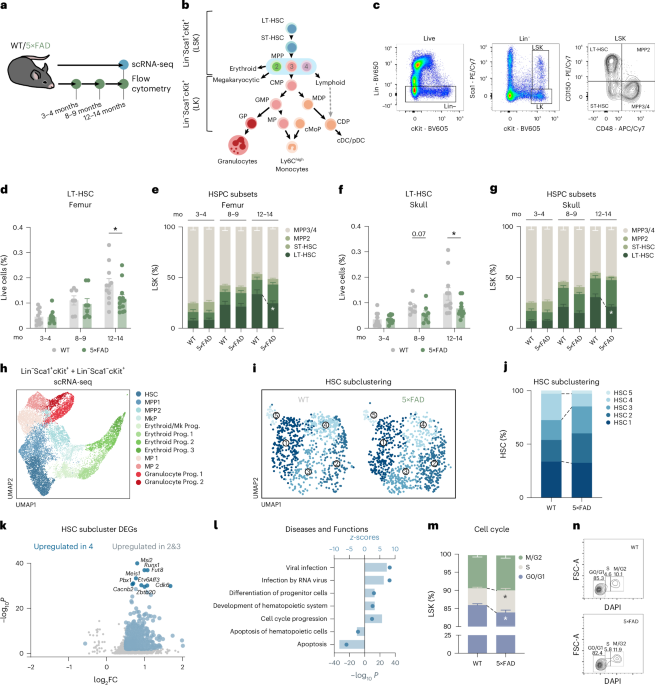
In this study, we discovered that monocyte development is impaired in mouse models and in patients. In the 5×FAD mouse model, monocyte differentiation was disrupted due to a maladaptive type I interferon (IFN-I)-mediated bone marrow response. A similar phenotype was found in circulating monocytes from patients with AD.
Blocking IFN-I signaling with neutralizing antibodies or reconstituting 5×FAD mice with IFN-I receptor-deficient bone marrow restored myelopoiesis, normalized monocyte phenotypes and ameliorated disease pathology. This was accompanied by increased homing of monocyte-derived macrophages to the brain. Our results reveal a dysfunction in bone marrow myelopoiesis in AD and reinforce the concept that AD progression is driven by maladaptive systemic processes.
This is a preview of subscription content, access via your institution Access Nature and 54 other Nature Portfolio journals Get Nature+, our best-value online-access subscription Receive 12 print issues and online access Prices may be subject to local taxes which are calculated during checkout Transcriptomic sequencing data generated in this study are available in the Gene Expression Omnibus database (GSE329430). Complete lists of DEGs and IPA results can be found in the Supplementary Information. All other raw data are available from the corresponding authors upon reasonable request.
No custom software codes were used in the data analysis for this paper. A., Purnapatre, M., Burgaletto, C. & Schwartz, M. Monocyte-derived macrophages act as reinforcements when microglia fall short in Alzheimer’s disease.
Neurosci. 28, 436–445 (2025). A unique microglia type associated with restricting development of Alzheimer’s disease. Cell 169, 1276–1290 (2017).
Extract — continue reading at the source.


