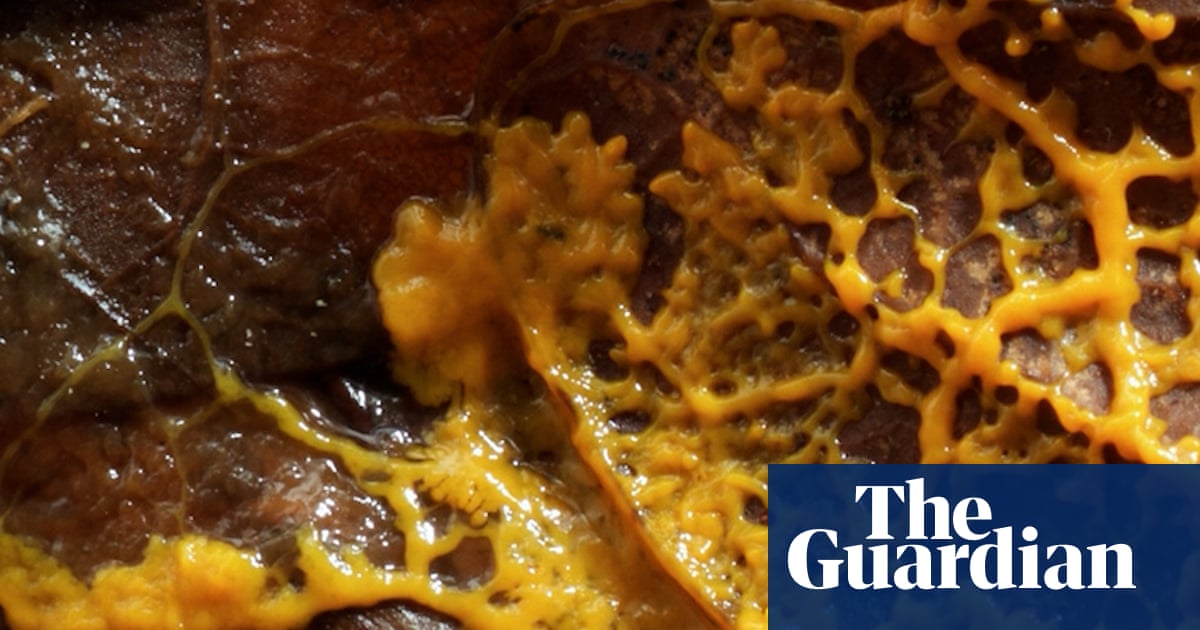
Forty years ago, as an undergraduate in Hokkaido, Toshiyuki Nakagaki came upon a lemon-yellow stain in a petri dish. That encounter turned him into a doyen of slime mould research – and fed a storm of biological and philosophical debate about the meanings of life and intelligence that persists to this day. Before, no one would have called a slime mould “intelligent”; the popular adjective, in fact, was “simple”.
And it was hard to argue otherwise. A slime mould can appear to be just a small cell, capable only of feeding and reproducing. Simple is as simple does.
Of that first meeting, Nakagaki said: “I was just impressed with how fast it moved.” Physarum polycephalum, the slime mould species in that petri dish, has a top speed of 1cm an hour. For amoebic organisms, that’s gold-medal standard. At first glance, Physarum seems to spread as irregularly as ink on blotting paper, but in fact it senses its meals of bacteria or other microbes and reaches for them with a long, thin finger of protoplasm – which not only digests its food but then forages further or pulls back into the rest of the mould.
It’s impossible to watch a slime mould over many days without sensing some deliberation at play. Physarum is often found as a glistening patch creeping over leaf litter in forests; hence its nickname: “dog vomit mould”. Even at its most expansive, occupying a couple of square metres, it is a single cell containing many nuclei – the tiny microdots holding its DNA. (Technically, this kind of structure is called a “syncytium”.) The fact that you can see it with the naked eye, and even perceive the swells and contractions of the protoplasm within, makes it ideal for experiments.
In 2000, his astonishing research began to surface in the media. Nakagaki placed oat flakes to resemble the map of Tokyo and 35 of its satellite towns. Then he let the Physarum loose from the centre of “Tokyo”.
From that one metropolitan oat, the mould spread outwards seeking the others, stretching towards them with its tubules. Then, putting out more branches, it linked up with itself, from one suburban oat flake to the next. In doing all this, the mould displayed such a verve for efficiency – no wasted motion, an optimal pursuit of its food – that it ended up nearly retracing the route map of the greater Tokyo area’s railway system.
Extract — continue reading at the source.


