Boredom has attracted considerable research interest, particularly boredom in learning and achievement contexts. However, boredom in learning outside of compulsory schooling and higher education has rarely been investigated. We therefore examined museum visits as such a context.
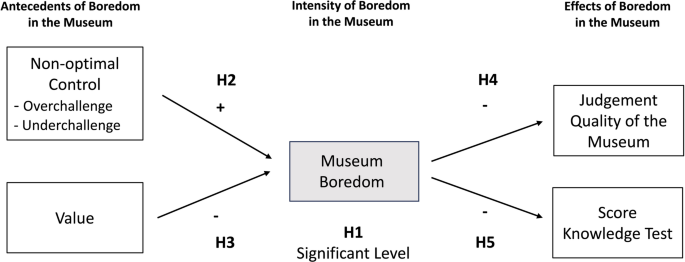
Drawing on control-value theory (CVT), we used quantitative situated assessments and qualitative interviews to investigate the occurrence, antecedents, and consequences of museum boredom. Across three studies (N = 1269, ages 18–91), we complemented individual findings with an internal meta-analysis. On a 1–5 scale, the meta-analytic mean level of museum boredom was \(\overline\) = 1.74.
Consistent with CVT, museum boredom was positively related to feeling overchallenged (\(\overline\) = .23) and underchallenged (\(\overline\)= .35). As expected, boredom was negatively related to perceived value (\(\overline\)= − .34/− .28 for personal/general value). Museum boredom was also negatively related to judgments of museum quality (\(\overline\) = − .18) and to knowledge acquisition during the visit (r = − .23).
Qualitative interview data identified specific facets of over- and underchallenge (e.g., too much information, empty rooms) and value (e.g., importance for one’s life path) during museum visits. Directions for future research and practical implications are discussed. After the audio section, there was a large room with even more information to read, but it felt overwhelming.
That’s when I decided to leave the museum” (from an interview with a participant). In the past 15 years, interest in boredom has grown markedly in the research community1. This growth is driven in part by accumulating empirical evidence of the adverse effects of boredom on important outcomes, including poor health, unhealthy eating habits, reduced motivation, and lack of achievement2.
There is an especially strong line of research on boredom as experienced in learning and achievement contexts3. However, learning contexts outside compulsory schooling and higher education—which play an important role in lifelong learning—have largely been neglected. Museums are one such context, representing a multifaceted arena for learning.
Extract — continue reading at the source.


