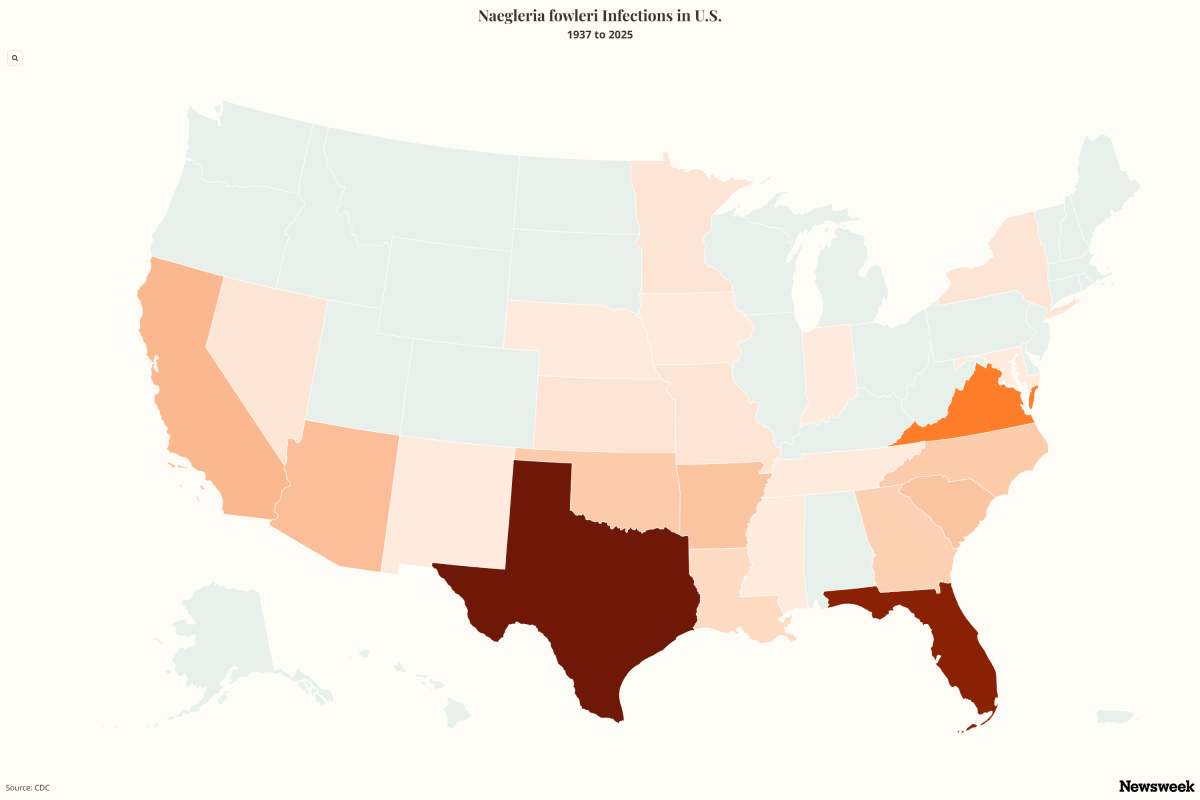
A North Carolina teenager is critically ill after contracting a rare brain infection caused by Naegleria fowleri, commonly known as a brain-eating amoeba, prompting renewed attention to where the deadly organism has been detected across the United States. While infections remain extremely uncommon, historical data from the Centers for Disease Control and Prevention (CDC) show cases have been reported in multiple states over the decades, with the highest numbers concentrated in the South. According to CDC data, 173 U.S. cases of primary amebic meningoencephalitis (PAM), caused by Naegleria fowleri, were linked to known exposure between 1937 and 2025.
Texas and Florida have recorded the most cases, followed by Virginia and California, though infections have also been reported in northern states. The amoeba is typically found in warm freshwater lakes, ponds and rivers and can infect people when contaminated water enters the nose, usually during swimming or diving. The North Carolina case comes less than a week after an 8-year-old Louisiana girl died from the same infection, highlighting how even a disease that affects fewer than 10 people annually in the U.S. can draw intense public concern because of its rapid progression and high fatality rate.
Newsweek reached out to the CDC via email for comment. The North Carolina Department of Health and Human Services announced the case on August 27, saying the patient is receiving medical care while authorities investigate where the exposure occurred. Officials noted that the amoeba is commonly found in warm freshwater environments such as lakes, ponds and rivers, particularly during periods of hot weather.
Officials did not release the patient's identity. "Our hearts go out to this teen’s family, friends and loved ones as they navigate this difficult time," North Carolina State Epidemiologist Zack Moore said in a press release. "While these infections are very rare, this is an important reminder that this amoeba is present in our state and across the U.S.
There are steps people can take to reduce their risk of infection while swimming during the warmer months.” Naegleria fowleri is a microscopic, single-celled organism that lives naturally in warm freshwater environments, including lakes, rivers, ponds and hot springs. It can cause a rare but devastating infection known as primary amebic meningoencephalitis (PAM) when water containing the organism enters a person's nose. The amoeba then travels to the brain, where it destroys brain tissue and triggers severe inflammation.
People cannot become infected by drinking contaminated water, and the infection does not spread from person to person. Although Naegleria fowleri infections are extremely rare, they are almost always fatal. The CDC says fewer than 10 cases are typically reported in the United States each year.
Extract — continue reading at the source.