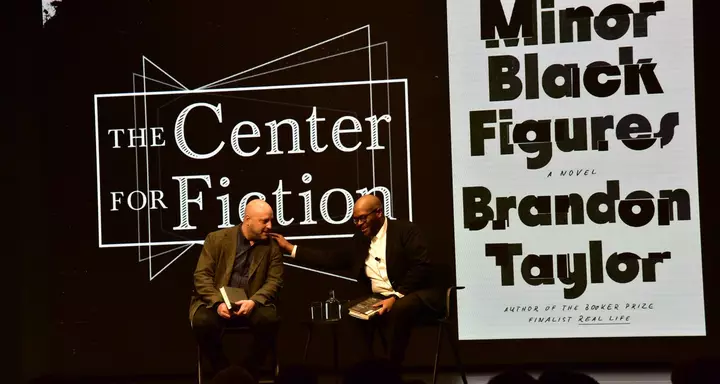
The Center For Fiction welcomed Brandon Taylor, Booker Prize finalist and bestselling author of Real Life and Filthy Animals, back to our stage to celebrate the release of his highly anticipated novel Minor Black Figures. Matthew Sitman, host of the Know Your Enemy podcast, joined Taylor in conversation. In Minor Black Figures, Taylor casts a sharp gaze on the New York art scene through the eyes of Wyeth, a young Black painter caught in the throes of creative struggle.
As Wyeth searches for inspiration, he confronts the fraught relationship between Black and white art and wrestles with the complex ways the Black body is perceived and represented. Alongside these tensions, he also faces compromises demanded of artmaking and the simple act of living. Matthew Sitman: The thing I really was interested in was the choice of making Wyeth an artist—a painter, and not a writer, and how much you were able to riff on, write about, think through the creative process in that different mode.
And I think especially interesting to me were the dynamics around him being a Black painter and the perception of Black art in this space you’re describing in New York City, this elite Soho gallery space. And there was one line in particular I wanted to read because it’s about a painter, but I wondered if you felt this applied to you as a writer, too. There is a kind of racist, essentialist logic to a lot of the way that we talk about art, especially Black art in this country.
And it is when Wyeth is talking to Chloe, this is the line: “every Black painter had two careers, a career among their Black contemporaries and a career among their white contemporaries. As much as he hated that logic, after all, some Black painters weren’t famous because they were bad painters. But it did have, at bottom, a sense of truth.” And I just wondered, again, you’re a writer, but this painter.
It was very interesting to me to follow along as this painter worked through the dynamics around race in his art and especially in that moment. Brandon Taylor: Gonna get me in trouble. I knew, I felt it, it’s all my Catholic slander.
I certainly feel that way, there is how your work is conceived, received and conceptualized and contextualized among your Black peers when you’re a Black writer, a Black artist, or a Black anything. They talk about you in the context of how your work fits into various other discourses around Black art. And then there is a conversation about your work and how it intersects or sort of integrates into larger artistic discourses about America or whatever, or the contemporary moment.
Extract — continue reading at the source.