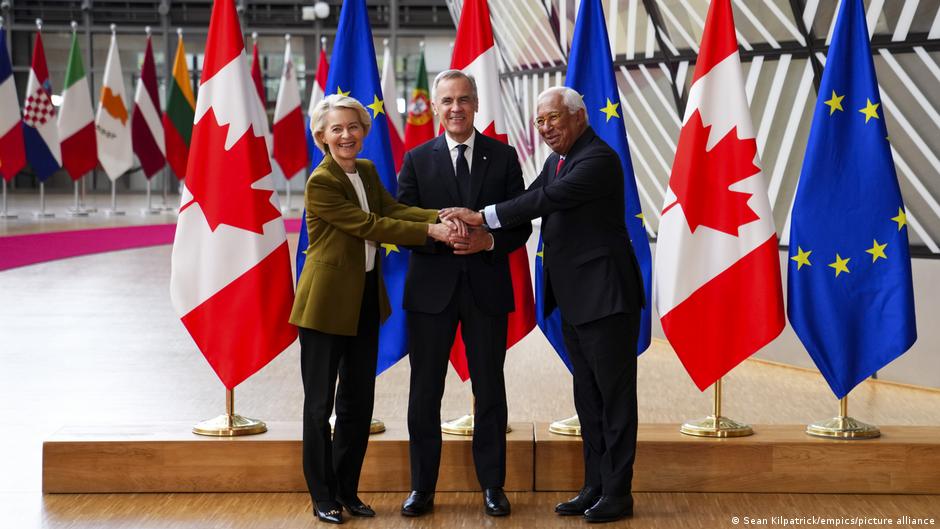
Before taking off for Europe, CanadianPrime Minister Mark Carney had set the tone for his visit, saying he was seeking to build a "unique alliance" with the EU. The Wall Street Journal similarly reported that Canada was considering becoming an "associate member" of the EU, while not aiming for full membership. In her State of the European Union address on Wednesday, European Commission President Ursula von der Leyen indicated that she was indeed open to such an expanded partnership.
"We believe that power does not belong to the strongest, the richest or the loudest, but to all of us," she said, addressing European lawmakers and Carney in Strasbourg, France. "That democracies have the freedom to choose with whom to work." Von der Leyen said a EU-Canada partnership would cover a broad range of areas including advanced manufacturing, technology, defense production, the Arctic, energy, critical minerals, batteries, artificial intelligence, quantum computing, cybersecurity and economic security. Carney is expected to outline his vision for future relations between the EU and Canada during a speech at the European Parliament on Thursday.
EU member states are closely integrated economically, sharing a common market, trade and customs policy. When it comes to establishing ties with non-EU countries, a list of different options present themselves. They range from free trade agreements that scrap tariffs and trade barriers, to association agreements which may include political elements, to far-reaching economic arrangements such as participation in the common European market, as is the case for Iceland, Liechtenstein and Norway.
The EU has already negotiated association agreements with Turkey, Israel and Ukraine. These have different objectives and may or may not mark a preliminary step toward full membership. Patrick Leblond, an expert on international economic relations at the University of Ottawa, urges a little more caution around the term "association agreement." He considers it unlikely that Canada would adopt European laws or join the EU single market or customs union, which would mean imposing common external tariffs.
Leblond says Carney is likely more interested in forming a kind of alliance that deepens cooperation on issues of economic security and defense. "We have, in a way, taken the US [security] umbrella for granted on both sides. We have underinvested in our militaries," Leblond told DW.
He added that the focus was now on joining forces, for example in the production of military equipment and the development of new technologies. Security analyst Anand Sundar of the European Council on Foreign Relations also sees great potential for European-Canadian cooperation when it comes to defense. Canada spends about 70% of its defense budget on US-made equipment, according to Sundar.
Extract — continue reading at the source.