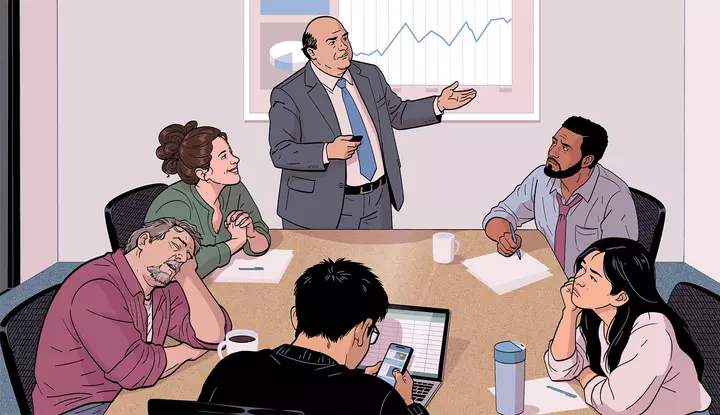
With a new trove of data from virtual meetings, scientists are making progress in figuring out how to make work gatherings better. The research is rolling in, and the answer is yes. It’s possible to turn tedious work gatherings into more effective _and_ enjoyable experiences.
Close to 1 billion meetings take place each day around the world. CEOs spend nearly three-quarters of their workdays in meetings. Planning for and spearheading meetings eats up the lion’s share of managers’ time.
In much of the industrialized world, meetings are both the metronomes and menaces of people’s working lives. Given the enormous time spent in workplace meetings, do we know what they accomplish or how to make them as worthwhile as possible? For decades, the answer was … not really.
Meetings weren’t a particularly accessible subject of study. Once a tiny niche area, “meeting science” is a growing specialization among organizational and social psychologists. The field is accelerating as archived virtual meetings provide vast swaths of data.
And it is providing a fascinating window into human behavior. How to deal with work stress — and actually recover from burnout Meeting to talk helps fulfill basic human needs to connect, communicate and cooperate. People have long come together — in caves, fields, market squares and town halls — to get something done, share ideas, get on the same page or just to remark on the weather.
But meeting scientists define their subject as gatherings of people “with some goal or structure to the event,” says organizational psychologist Liana Kreamer of the Florida Institute of Technology, who coauthored a review of over three decades of meeting science in the 2026 _Annual Review of Organizational Psychology and Organizational Behavior_. As a graduate student, Kreamer was interested in studying teamwork, leadership and work relationships. During her doctorate work with meeting scientist Steven Rogelberg, she realized that meetings would be a fine venue for studying all of that and more.
Extract — continue reading at the source.