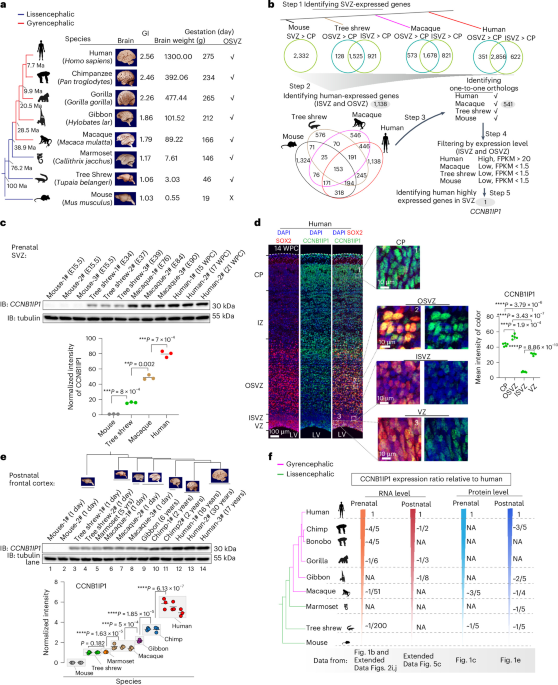
The gradual expansion and folding of the cortex are key factors in human cognitive evolution, yet their molecular underpinnings remain not well understood. Here we identify cyclin B1 interacting protein 1 (CCNB1IP1) gene as a key regulator of human brain evolution using tree shrew as an outgroup. In primates, CCNB1IP1 acquired brain expression and gradually increased its expression during evolution, mirroring the increase of cortical size and folding.
Comparative analysis of cis-regulatory elements reveals evolutionary changes underlying the increase of CCNB1IP1 expression. Overexpression of CCNB1IP1 affects the cell cycle, increasing the abundance of basal progenitors and neurons. Mechanistically, we demonstrated that CCNB1IP1 represses the transcription factor E2F1 through the ubiquitin-mediated degradation pathway.
Moreover, CCNB1IP1 knock-in can develop cortical folding in otherwise smooth mouse brains. These findings reveal that evolutionary changes in CCNB1IP1 expression have contributed to the enlargement and folding of the primate cortex. This is a preview of subscription content, access via your institution Access Nature and 54 other Nature Portfolio journals Get Nature+, our best-value online-access subscription Receive 12 print issues and online access Prices may be subject to local taxes which are calculated during checkout All sequencing data were deposited at the NCBI GEO under accession nos.
Source data are provided with this paper. A., Santpere, G., Gulden, F. Evolution of the human nervous system function, structure, and development.
Cell 170, 226–247 https://doi.org/10.1016/j.cell.2017.06.036 (2017). Article PubMed PubMed Central CAS Google Scholar Lui, J. Development and evolution of the human neocortex.
Cell 146, 18–36 https://doi.org/10.1016/j.cell.2011.06.030 (2011). Human-specific genetics: new tools to explore the molecular and cellular basis of human evolution. Genet. 24, 687–711 https://doi.org/10.1038/s41576-022-00568-4 (2023).
Extract — continue reading at the source.


