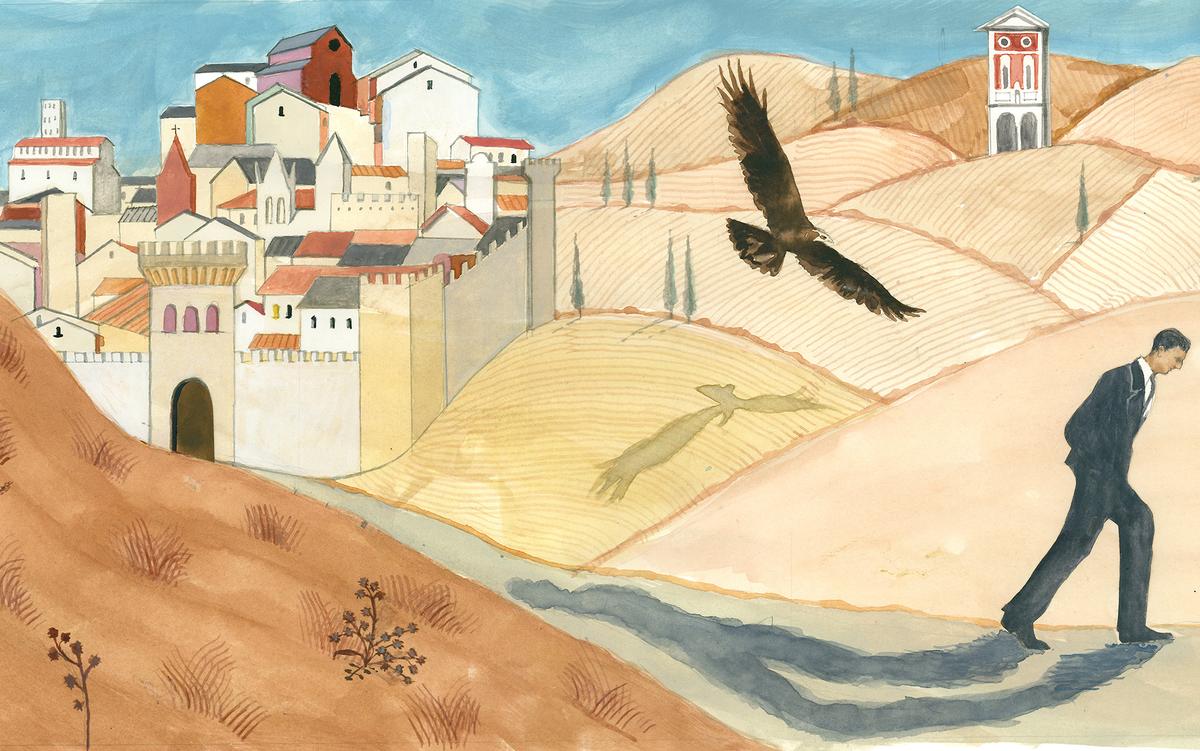
All original watercolours by Emily Faccini When he was a child growing up in Emilia-Romagna, my great-grandfather Marco once found an eagle fledgling that had fallen from its nest. He kept it warm in the folds of his shirt and ran home, only to discover as he undressed that the bird had eaten strips of his flesh, its beak tinged red with blood. The rescued eagle thrived in my great-grandfather’s care, its wingspan soon a remarkable length.
And all the while, Marco himself grew immensely tall. Then, one day, without warning, the eagle flew away. The moment my father told me this story when I was a boy, it lodged itself deep in my imagination.
I pictured young Marco as a giant striding through the forests of north-central Italy, calling to the bird of prey, waiting in vain for it to land on his outstretched hand. Marco merged with the heroes of my illustrated classical civilisation books, earning his place between the busts of Roman emperors and the chapters on Greek mythology. What I never realised was that this family legend held clues to who I am and to my relationship to Italy.
Lina Stores deli in Soho, London, has been a pillar of Italian life in England for decades. It’s where we’d sometimes meet our paternal grandparents when visiting London from our home in France. My brothers and I would line up in front of the refrigerated counter and ask for our favourite ravioli, doing our utmost to avoid any slip-ups in Italian that would make the staff wince: ‘ricotta e spinaci’, ‘zucca’, ‘funghi porcini’.
Back at our grandparents’ flat, Nonna served the ravioli on an elaborately laid table, and my grandfather appeared with freshly grated Parmigiano. He’d sprinkle the cheese evenly over our pasta; never too much, nor too little. How he did this, and with such speed, we didn’t know.
If we had spaghetti, Nonna would wrap her right hand around ours and twirl the fork with us so we held just the right amount, the bespattered tablecloth damning proof of our slapdash habits at home. My grandparents trusted that these rituals of the table (they saw them as basic codes of Italianness, connecting displaced Italians everywhere) would allow us to paper over the differences in our ethnically blended and peripatetic family. In this way, we’d be able to claim Italian identity for ourselves, despite its competition in our lives with Englishness and Frenchness.
Extract — continue reading at the source.