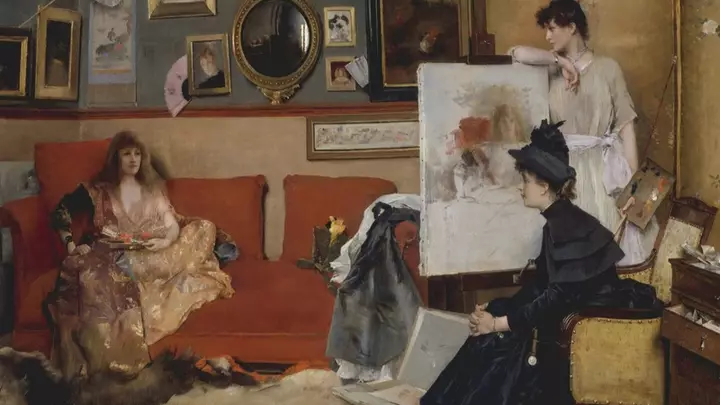
Is it telling that I was always more interested in the amateurs? When I think about the literary depictions of artists I liked best, they tend to share certain qualities: frustrated effort, a willfulness about vocation that verges on delusion, persistence despite the indifference of others and the uncertainty of the rewards. The blueprint for this preference is the shy, thwarted Lily Briscoe in Virginia Woolf’s 1927 novel To the Lighthouse.
Lily fears the judgement of Mr. Ramsay that would inevitably flow from his looking at her picture, but is also floored with melancholy when she considers how it will most likely (as was a common fate for women artists) be “rolled up and stuffed under a sofa.” Painting for Lily is at once pleasurable, a “dancing rhythmical movement” that Woolf describes in tactile detail and a battle with “an ancient formidable enemy.” Lily’s inner life is consumed by this ambivalence, but it isn’t clear whether she is actually a talented painter, and it seems certain that she is right to think her work won’t ever be displayed. Woolf treats this psychic drama seriously and with great generosity and tenderness.
What matters isn’t the quality of Lily’s work but the quality of her devotion. I have tried in the past to use my knowledge of British art to visualize Lily’s picture, to gather together the various ekphrastic fragment Woolf inserts into the narrative and construct an equivalent. I remain unconvinced by the easy comparisons between Lily and Woolf’s artist sister Vanessa Bell, who was much more professionalized (and privileged) than Lily. (Only a few years after To the Lighthouse was published, Woolf wrote a forward to an exhibition catalogue for a solo show of Bell’s work in a gallery on Bond Street.
She was an artist of reputation, Woolf writes, who was argued about at dinner parties. This isn’t Lily’s trajectory.) Lily is probably another disciple of British Post-Impressionism, but this isn’t what Woolf finds interesting about her painting. The meaning is largely in the emotion and intelligence Lily brings to bear upon her work, the process, the insistent intertwining of her creativity and her becoming.
Lily’s status as an amateur makes this struggle all the more poignant. Her striving is never about securing acclaim or proving that her sacrifices have been worthwhile (she is unmarried, unmarriageable, in part because of her unwillingness to deprioritize her creative pursuits). Her painting is more about subtle internal relationships between herself and, as she refers to it in the triumphant final passages of the novel, her vision.
Art makes her happy, it puts her in a curious and purposeful relationship to the world, and that’s enough. I have always liked the humble yet doggedly workmanlike image of artistic personhood Lily embodies. Her shame about her work being seen yet her drive to keep making it resonated with me.
Extract — continue reading at the source.