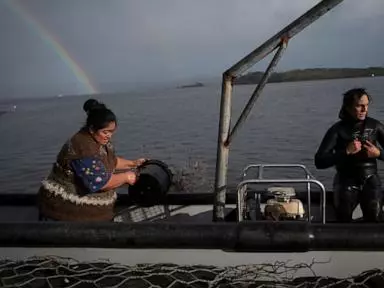
The remote Guaitecas Archipelago has more than 40 small islands and is a gateway to Chile’s Patagonia region MELINKA, Chile -- Yesica Fabiana Leviñanco steers her small wooden boat while her partner, Paulo Vera Perez, dives into the cold ocean waters off the coast of southern Chile. Within a few hours the couple, both in their mid-40s, has filled the boat with shellfish, sea urchins, mussels and crabs that Leviñanco will sell at the market in Melinka, the main island in the Guaitecas Archipelago. Even a few years ago, such a haul would have been unthinkable.
A salmon-farming facility had destroyed everything.” EDITORS' NOTE: This story was supported by Journalismfund Europe. Made up of more than 40 small islands, the Guaitecas Archipelago is a gateway to Chile’s Patagonia region that is one of the world’s most remote places. Despite being a national reserve, it’s also home to numerous salmon farms that discharge hundreds of tons of chemicals and antibiotics into the sea every year.
At least 313 salmon farms were authorized in the archipelago, according to Chile’s National Fisheries and Aquaculture Service, called Sernapesca. Leviñanco and Vera Perez say the intensive farming damaged where they fished, so they decided to try to counter that. They started bringing in healthy mussels and clams from other areas.
Friends and family thought they were crazy, but over years the work paid off. Chile is the world’s second-largest salmon producer after Norway, and the fish is the Latin American country’s second-most exported product, after copper. In 2025, over 1 million tonnes were produced in the country, according to Sernapesca.
Salmon is not native to Chilean waters. The fish was first imported from Norway in the 1970s and 1980s, during the dictatorship of Gen. For years, intensive salmon farming in Chile has been criticized by scientists, environmental advocacy groups, fishers, Indigenous communities and local residents, who accuse the industry of polluting the sea because of the large quantities of chemicals used at the farms, failing to respect the rights of Indigenous communities and breaching workplace safety regulations.
According to figures provided by the Chilean nonprofit Ecoceanos, 90 workers have died in the industry since 2013. Fatal accidents range from workers getting entangled while cleaning nets to shipwrecks among vessels in the area. The Guaitecas Archipelago is the largest nature reserve in the country and one of the oldest, having been established in 1938, and has many endangered marine species.
Extract — continue reading at the source.