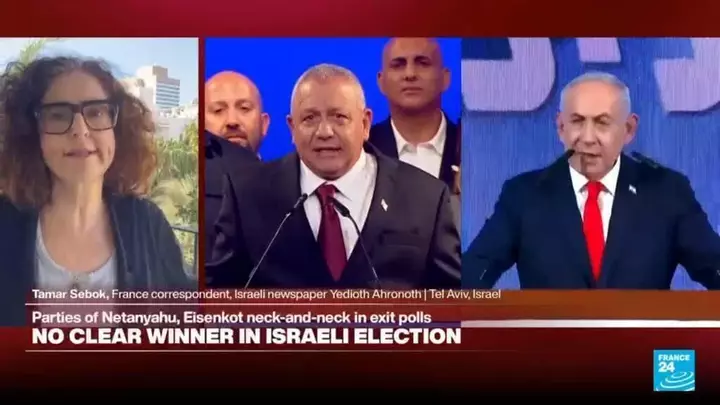
We and our partners do the following data processing based on your consent: store and/or access information on a device, personalised advertising and content, advertising and content measurement, audience research and services development To display this content from YouTube, you must enable advertisement tracking and audience measurement. One of your browser extensions seems to be blocking the video player from loading. To watch this content, you may need to disable it on this site. 'Israeli president trying to form unity govt: They will not need Arab parties nor Orthodox parties' Oliver Farry is pleased to welcome Tamar Sebok, correspondent for the Israeli daily Yedioth Ahronoth based in France.
In an Israeli election marked by political uncertainty, unusually high voter participation and a significant mobilisation of Arab voters, the struggle for power extends far beyond the ballot box. As Sebok explains, the decisive question is not necessarily which party wins the most seats, but which political leader can assemble a viable governing coalition.“You don't know until the coalition is formed who really won,” Sebok observes, capturing the fundamental uncertainty of Israel's parliamentary system. It's the question of what kind of acceptance you get from the other parties.”Her analysis illuminates a central paradox of coalition politics: smaller parties can exercise influence disproportionate to their electoral strength when larger parties depend on them to secure a parliamentary majority.
As Sebok puts it, “The small parties who are the balance have a lot more power than the big ones. It's a contradiction.”Particularly significant is Sebok's insistence that public declarations excluding cooperation with Arab parties should not necessarily be understood as definitive. Recalling the coalition negotiations of 2021, she argues that the boundaries of political cooperation can shift considerably once electoral campaigning gives way to the practical demands of government formation.“The Arab parties have never been that strong,” she notes, before offering a conclusion that encapsulates both the uncertainty and the possibilities of the political moment: “So everything is open.” REPLAY: Spanish Transport Minister gives press conference on train crash Spain: Dozens killed after one high-speed train slams into another Ukraine: Melania Trump-brokered local ceasefire holds for second day Mbappé's China faux pas: When the sports world collides with the complexities of geopolitics Israeli election: PM loses a significant number of seats since 2022 election Brazil: Flavio Bolsonaro leaves Argentina for alleged US asylum after defeat Israeli election: As votes are counted, no clear winner emerges © 2026 Copyright France 24 - All rights reserved.
France 24 is not responsible for the content of external websites. Audience ratings certified by ACPM.ACPM The content you requested does not exist or is not available anymore.
Extract — continue reading at the source.