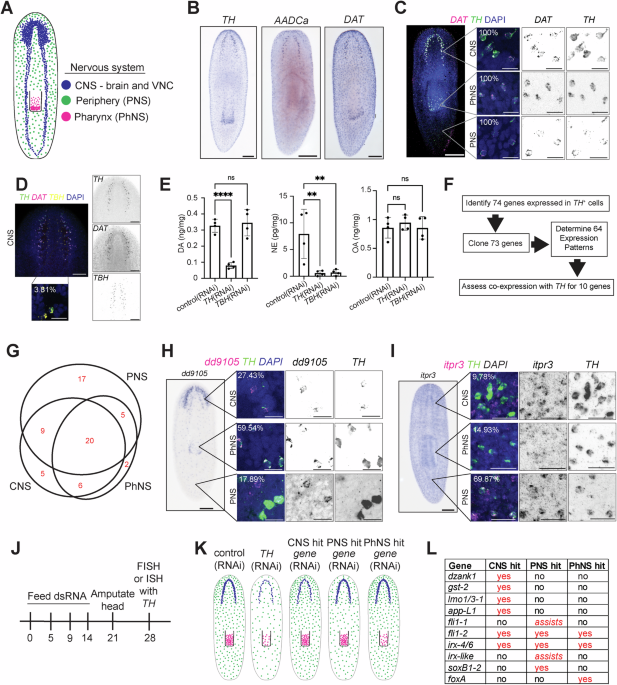
Regenerative neurogenesis can drive replacement of neurons in the right types and locations to faithfully restore form and function after injury. The genetic mechanisms underlying successful regenerative neurogenesis, including mechanisms that produce neuronal diversity and spatial organization, remain poorly understood. Planarians are flatworms with extraordinary capacity for brain regeneration made possible by pluripotent stem cells throughout the body that undergo neurogenesis to form a complex nervous system anew after injury.
Here, we focus on the dopaminergic neuron identity and report the discovery of factors important for regenerative neurogenesis of this neuron type in the planarian central, peripheral, and pharyngeal nervous systems. Distinct genes, including irx4/6, fli1-2, soxB1-2, foxA, app-L1, and lmo1/3-1, promote dopaminergic neuronal regeneration and maintenance in distinct parts of the nervous system. Our results demonstrate that planarian neurogenesis requires coordination of factors that initiate neurotransmitter choice and regional location.
Our work suggests that combinatorial instruction of cell type and spatial identity could improve exogenous stem cell therapies aimed at precisely replacing neurons after localized injuries. Developmental neurogenesis involves neuronal birth from progenitors with predictable timing and within specific environments within a growing animal. In contrast, regenerative neurogenesis occurs outside normal developmental timing, with nascent cells and surviving bystanders intermingling unpredictably at the injury site.
Repairing injury also requires production of an unpredictable number and type of neurons, with the ideal outcome being faithful reproduction of correct cell types and ratios for a given location. In some organisms, regenerative neurogenesis occurs through a pool of localized progenitors that give rise to mature cell types in distinct regions1. However, in many animals, including humans, regenerative neurogenesis in the central nervous system (CNS) occurs infrequently in only a few areas2,3.
Translational approaches in regenerative medicine have evolved to combat this deficit. However, iPSC-derived neurons, such as human midbrain dopaminergic neurons, cannot be transplanted without challenges. After 6–12 weeks, less than 30% of engrafted cells show signatures of mature dopaminergic neurons, and migration of engrafted cells has been observed4,5,6.
In the last year, dopamine cell therapies have reached Phase I/II clinical trials, but further studies are needed to ensure long-term results7,8. Therefore, understanding how to induce regenerative neurogenesis or how to improve the incorporation of exogenous cells toward disease- or injury-specific outcomes could revolutionize therapies for neurodegenerative diseases and other CNS injuries. We use the planarian model system to understand successful regenerative neurogenesis.
Extract — continue reading at the source.


