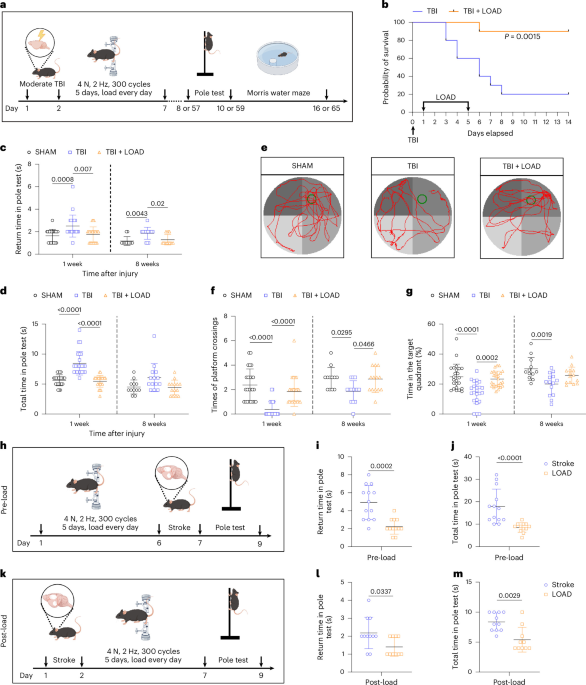
Traumatic brain injury (TBI) accelerates bone healing and induces heterotopic ossification, raising the question of whether an injured brain benefits from bone. Here we reveal that dynamic compressive tibial axial loading (DCTAL), a model of tibial bone compression, increased survival and promoted motor and cognitive recovery after stroke and TBI in mice, as well as in pig TBI models. DCTAL reduced neuron loss, attenuated chronic inflammation and astrogliosis and stimulated neuronal regeneration after TBI.
Deletion of the mechanosensory channel Piezo1 in osteocytes reversed these benefits, while serum from DCTAL mice recapitulated them. Osteocytes transduced mechanical signals to directly secrete factors such as IL-1R2, APOL11a and HSP70, while indirectly increasing serum levels of BDNF, PF4 and dopamine. These factors synergistically protected against TBI.
Altogether, we establish a bone–brain axis in which bone endocrine function can be modulated by mechanical forces to enhance brain repair after injury. This is a preview of subscription content, access via your institution Access Nature and 54 other Nature Portfolio journals Get Nature+, our best-value online-access subscription Receive 12 print issues and online access Prices may be subject to local taxes which are calculated during checkout RNA-seq data related to Fig. 5 and Extended Data Figs. 4 and 8 had been submitted to the National Genomics Data Center (accession: PRJNA1242536 and PRJNA1371673). RNA-seq data related to Fig. 6 and Extended Data Fig. 6 from previous research used here are accessible via PRJCA019393 (ref. 12).
Source data are provided with this paper. No custom code was generated for this study. All software and algorithms used are described in the Methods and are publicly available.
Traumatic brain injury: a global challenge. Lancet Neurol. 16, 949–950 (2017). Blennow, K., Hardy, J. & Zetterberg, H.
The neuropathology and neurobiology of traumatic brain injury. Neuron 76, 886–899 (2012). Traumatic brain injury: progress and challenges in prevention, clinical care, and research.
Extract — continue reading at the source.


