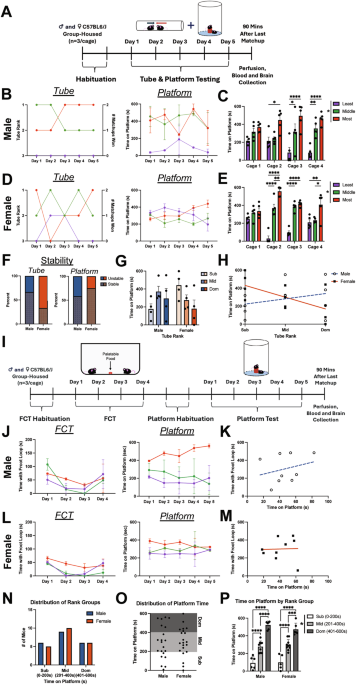
Social hierarchy influences behavior, resource access, and health, but the neural mechanisms underlying individual differences in social competition remain incompletely understood. Using a novel competitive platform test and assessment of region-specific activation in male and female mice, we found a range of social hierarchies as determined by time on platform, revealing greater behavioral complexity than previously described and improved stability in females. We also measured motivated behavior and saw reduced platform acquisition attempts over testing days as well as rank-dependent differences in platform co-occupancy, which were seen primarily amongst lower ranks.
We found no association between rank and medial prefrontal cortex (mPFC) activation, but found a positive correlation between lateral habenula (LHb) activation and rank. Social dominance was magnified in a group setting compared to paired matchups with similar motivation and co-occupancy behavior between ranks. There was no association between rank and mPFC activation in a group setting, but the LHb was again positively correlated with rank.
Collectively, these findings demonstrate that the competitive platform task captures individual differences in social competition, motivation, and resource-sharing behavior under an aversive stimulus and identify the LHb as a neural correlate of performance in this behavioral context. These results highlight the complexity of social interactions in both sexes and provide insight into neural mechanisms that contribute to competitive social behavior. Social hierarchies are characterized by self-organization of individuals into dominant or subordinate ranks [1, 2].
Social rank has profound influence on the daily behavior of individuals within a social group and promotes reproductive success, conservation of energy and resources, and maximized survival for the entire social group [2, 3]. Despite its importance for individuals and groups, our current understanding of the neural mechanisms underlying social competition and hierarchy-related behaviors is limited, especially in females. A more in-depth analysis of the complexity of social competition behaviors and resource-access dynamics in both sexes would provide an improved understanding of underlying neurobiology.
Preclinical studies of social hierarchy and social competition in rodents employ behavioral assays [4,5,6,7,8,9,10,11,12,13,14,15,16] that provide insight into social rank and competitive interactions, where behavioral outcomes are commonly quantified through either agonistic encounters, which quantify offensive (dominant) and defensive (subordinate) behaviors [5, 8, 15,16,17], or through competition for resource access, where dominance is measured by success in acquiring or maintaining access to limited resources [1,2,3, 5,6,7, 9, 11, 14]. Agonistic encounters are effective for single-housed, group-housed, or barrier-housed male mice, but are less reliable at measuring hierarchy in female mice and can involve physical injuries that are stressful and may impact experimental outcomes [5, 15,16,17,18,19]. Resource competition assays are less aggression-based and can determine hierarchy in both sexes through competition for territory, mates, chow, palatable food, or water [3, 5,6,7, 11, 14].
Additional assays, including the warm spot test, urine scent marking paradigms, and ultrasonic vocalization-based measures, have also been used to probe dominance-related behaviors, each emphasizing distinct behavioral features associated with social status and competitive interactions [1,2,3, 5,6,7, 9, 11, 14]. Importantly, different dominance assays rely on distinct behavioral readouts, and relationships among measures can vary across studies, species, strains, and experimental conditions [5]. The tube test is an established assay that relies on the resource of space [1,2,3, 5,6,7, 9] and correlates with home cage dynamics and other resource-based dominance measures [2, 5]; however, its generalizability is influenced by species, strain, and sex, and its binary outcome and dyadic structure limit behavioral resolution and scalability to group-level dynamics [6].
Extract — continue reading at the source.